In plain words
What happens to this medium when a star collapses into a black hole? Short answer: nothing it can feel. The medium cannot be captured or squeezed by anything lighter than a million suns, a black hole is born without any pocket and keeps none, and the medium ignores the black hole's own heat entirely (the stars orbiting the black hole at the centre of our Galaxy prove it). The rest of the page is the fine print: what LIGO says about the grain of the vacuum, what the entropy of a crystal and the physics of glasses force on the picture, how much of Einstein's theory can be read as the elasticity of a lattice, and why spacetime itself is not the medium. Several ideas on this page were tried and withdrawn the same day; they are left visible, marked as such. Unfamiliar words are in the glossary.
Calculation 1 and 2
A collapse does not compress the medium; it is born with it or not at all.
A hot medium at 50 km/s is transparent to anything lighter than a million suns.
Take the medium as a Maxwellian population at σm and ask what a deepening well captures. The escape speed from a prestellar core, a star, or a 10 M☉ black hole at its MOND radius is below 1 km/s; the captured fraction of a 50 km/s medium is 10−7, its density enhancement 1.00, its radius of influence 10−6 pc. Only the cores of massive globular clusters, nuclear star clusters and supermassive black holes bind the hot medium (Sgr A*: 2–7 pc). The same arithmetic says that Segue 1, Crater II and the dwarf spheroidals (escape speeds 0.5–5 km/s) would not bind a universal 50 km/s medium either, and would be Newtonian. So the medium is not universally hot: it collapses with each structure, by the equivalence principle, and inherits that structure's virial dispersion. The 50–100 km/s of the Milky Way's medium is a property of the Milky Way.
| Object | Escape speed | Captured fraction, σm = 50 km/s | Radius of influence |
|---|---|---|---|
| Prestellar core, 1 M☉, 0.05 pc | 0.4 km/s | 1.5×10⁻⁷ | 2×10⁻⁶ pc |
| Black hole, 10 M☉, at its MOND radius 0.11 pc | 0.9 km/s | 1.4×10⁻⁶ | 2×10⁻⁵ pc |
| Pal 14 | 2.6 km/s | 4×10⁻⁵ | 0.03 pc |
| 47 Tuc core, 106 M☉ | 131 km/s | 0.92 | 1.7 pc |
| Sgr A* | 186 km/s at 1 pc | 1.00 | 6.9 pc |
In the cold reading, the pocket around a star is the medium that was bound to its natal core, contracted adiabatically as the gas fell to the centre. That contraction is self-similar: 22%, 12% and 6% of the bound medium end up above 10, 100 and 1000 times the core's central density, whatever the core's mass. If the medium only locked at high density, the outer 80% would stay bound and slack, orbiting the star at 0.5–5 a₀ and boosting wide binaries by 20–150% at 5,000–20,000 AU, exactly the signal Banik et al. (2024) exclude at 16–19σ. For the Solar System to be Newtonian the medium must lock at the density of a prestellar core itself. That fixes the locking density, and it withdraws the “occlusion edge” this site used to advertise.
Compact remnants are born naked
A supernova removes half the mass at once (a 20 M☉ star to a 10 M☉ black hole is exactly marginal) and kicks the remnant. A kick of 3 km/s strips every bound element at 0.05 pc; neutron stars lose their pocket by mass loss alone. Natal kicks are tens to hundreds of km/s. A stellar black hole therefore keeps no pocket; it sits in the galaxy's passing medium, which orbits the galaxy and transmits the hole's flux with gain 1. Newton, without memory. And the locked, massless part of a pocket is held by nothing gravitational at all: what it follows is the one open question this page cannot close.
Calculation 3
The bath is global.
The model defines a₀ as the acceleration whose Unruh temperature equals the temperature of the bath. A black hole is a second thermostat: for Sgr A* the Hawking temperature is 5×10¹⁵ times the de Sitter one. If the medium near the hole thermalised with its horizon, the local a₀ would be the surface gravity, the whole exterior would be in the deep-MOND regime, and every star around Sgr A* would circle at c/√2, 212,000 km/s. S2 reaches 8,000 km/s and follows Kepler to a percent.
| Tolerance on S2's acceleration | Transition law | Local a₀ below | Coupling to the hole's horizon, relative to the cosmological one |
|---|---|---|---|
| 1% | McGaugh | 3×10⁻⁴ m/s² | < 6×10⁻¹⁰ |
| 1% | exponential slack (1/u tail) | 7×10⁻⁵ m/s² | < 1×10⁻¹⁰ |
| 0.2% (Schwarzschild precession) | exponential slack | 1.4×10⁻⁵ m/s² | < 3×10⁻¹¹ |
The thermostat is the cosmological constant, not the nearest horizon. Hawking radiation does not rejuvenate the glass, a black hole is not a hot defect in the vacuum, and “acceleration heats it” on the vacuum page means the element's own acceleration, never an ambient one. This is the sharpest result of the page, and it holds in every reading of the model.
Conjectures, each with what would kill it
How a black hole forms, in a glass.
As it stands the model says only this: a collapse happens at u ~ 1020, the medium is saturated at Newton, it has no gravitating mass, and general relativity does the rest. Where the model does change black holes is the early Universe, on the First black holes page. The conjectures below take the vacuum-as-material seriously and ask what a horizon is to a glass.
The horizon is a tear.
A chain of elements along a field line is stretched, from infinity to r, by Φ/a₀. If the elastic energy of rupture per unit mass is c², the chain breaks at Φ = c²/2, that is at 2GM/c². The Schwarzschild radius as a Griffith criterion on integrated elongation, not on field. With a₀ = cH₀/2π, the breaking elongation is exactly πc/H₀: half the circumference of the cosmological horizon. No chain of the vacuum can be stretched further than the Universe is long. Withdrawn: the same day's spacetime section shows the waves, hence the horizon, do not live on this lattice; the identity πc/H₀ stays as a curiosity.
The vacuum creeps in.
Collapse takes u from 1 to 1020 in a free-fall time; every element yields and the medium creeps toward the mass. The river model of Painlevé–Gullstrand, space falling at √(2GM/r), becomes plastic creep, and the horizon is where the creep reaches c: an acoustic horizon in the sense of Unruh (1981), for a glass that flows.
A shell on a torn vacuum.
If nothing transmits the field inside the tear, the potential stops at c²/2 and matter piles up against the tear: a black hole with no singularity and a surface at exactly rs. With the surface exactly there it predicts no echoes, and says nothing testable; a surface at rs(1+ε) with ε set by the lattice spacing would echo at ~14 ms, where GWTC-4.0 sees nothing. Withdrawn: if the tensor sector lives in the continuum, a tear in the medium does not stop it, and the interior is Schwarzschild's.
Born naked, stays naked.
Kicks strip the pocket; the screened-vacuum bubble of the relativistic completion collapses with the star. A stellar black hole is the one compact object certainly outside any memory, and it feels no dynamical friction from the medium.
Primordial holes cap themselves.
Primordial black holes form at u = πδc ≈ 1.4, the only collapse the model ever sees near its transition; with the Hubble deceleration acting as an external field they get 7–15% extra gravity. But memory locks the medium of each collapsed patch, hundreds of comoving parsecs per hole. A primordial-hole dark matter would lock a matching fraction of the galactic medium and dilute the response SPARC measures to 10%: fPBH < 0.1, from the vacuum's memory rather than from lensing.
Supermassive holes grow in locked nuclei.
A galactic nucleus is born dense and its medium is locked over tens of parsecs, beyond the hole's 2–7 pc of influence. The hole grows in a Newtonian pocket that predates it, and the a₀ floor (0.3% of the enclosed mass at 10 pc) should exist only in secularly built pseudo-bulges, never in classical bulges.
GWTC-3, GWTC-4.0, GW250114, PBH constraints
Against the data.
One new number, several passes without discrimination, and one honest blank.
If gravitational waves were the shear waves of a lattice of spacing ℓ, the lattice dispersion would enter the LIGO–Virgo–KAGRA parametrisation as a negative A4 = −ℓ²/12ℏ². GWTC-4.0 (2026) bounds Ā4 above −0.62×10³ eV−2:

| Claim | Data | Outcome |
|---|---|---|
| Waves are lattice phonons (dispersion A4 < 0) | GWTC-4.0 modified-dispersion test | ℓ < 17 µm if the waves ride the lattice; the 0.22 mm threshold lattice is excluded by 13×. The spacetime section below turns this into a stronger statement: the waves do not ride the lattice at all. |
| No graviton mass | mg ≤ 1.92×10⁻²³ eV/c² (GWTC-4.0) | consistent; an elastic lattice has no mass term |
| Shell at rs, echoes | Four echo searches in GWTC-4.0, none in GWTC-3 | no evidence for echoes; the conjecture as stated predicts none, so it is empty |
| The glass yields in under a millisecond | GW250114: dominant quasinormal mode within a few percent of Kerr, overtone to tens of percent | consistent, not discriminating |
| fPBH < 0.1 from memory | LIGO O1: f < 0.01 for 10–300 M☉; microlensing f < 0.1 at 1–30 M☉ | compatible; 10–100 times weaker than existing bounds |
| Rates and masses of merging black holes | GWTC-3: 18–44 Gpc−3 yr−1, chirp-mass peaks 8.3 and 27.9 M☉; GWTC-4: peaks near 10 and 35 M☉, three subpopulations | no prediction for today's black holes: the medium has no friction and no effect on a collapse at u ~ 1020. These are stellar physics. The first black holes are another matter: see First black holes. |
Statistical mechanics, part one
Read as a crystal.
Treat the threshold elements as a lattice and apply the ordinary entropy of solids. Three identities and two verdicts fall out.
- Vibrational entropy: TdS/ΘDebye = 3×10⁻³¹; phonon entropy per element 10−90thermally a perfect crystal at absolute zero
- Configurational entropy of the Hubble volume, 10102 kB for ℓ = 0.22 mm; a Planck lattice would hold 10182, above the holographic bound of 10122ℓ ≥ 2 fm; the vacuum is the second entropy reservoir of the cosmos
- Broken bonds on the tear give an area law, S ∝ A/ℓ², but short of Bekenstein–Hawking by (ℓ/2ℓP)² = 1061Hawking entropy is not in the lattice
- Locking a 0.1 pc pocket: latent heat 4×10¹⁷ J, trapped elastic energy 9×1035 Jthe transition is mechanical (jamming), not thermal
- Mixing entropy of engaged and slack elements peaks at u = ln 2, i.e. g = 0.7 a₀the anomaly appears where the vacuum is most disordered
Statistical mechanics, part two
Read as a glass.
Glass physics is sharper than crystal physics here: it flips one sign on this site and selects one variant of the model.
The galactic medium is a solid. Above its transition a soft glass carries no stress at zero strain rate; a static phantom needs the solid phase. Everywhere the vacuum is a glassy solid; galaxies keep their slack, pockets have lost it. It is a strong glass, eternally marginal. Because a₀ tracks TdS, the ratio that governs relaxation never changes; the vacuum never falls out of equilibrium by cooling, relaxes once per Hubble time, and ages only mechanically. Λ keeps it a glass. The configurational entropy falls as ln H(t); with Λ it stays finite and MOND is permanent; with Λ = 0 the vacuum would reach its Kauzmann point and crystallise into Newton everywhere.
Glasses damp; the vacuum must not. Every real glass below 1 K has a universal internal friction Q−1 ≈ 3×10⁻⁴ from tunnelling two-level systems. GW170817 crossed 4×10¹⁷ wavelengths at 100 Hz with its amplitude consistent with the electromagnetic distance to 20%: Q−1 < 2×10⁻¹⁹. The vacuum is not a glass for its phonons. It has two components: a lossless crystalline backbone that carries the waves, and on it an orientational glass, frozen directors on smooth layers, that carries the slack, the memory and the residual entropy. That is the smectic medium of the model page, selected here against the isotropic soft glass. Two more consequences: a shaken glass rejuvenates, so tidally disturbed dwarfs should respond more than MOND's external-field effect predicts (Crater II, 2.7 measured against 2.1: the right sign); and a sheared glass crackles, which the survival of old open clusters bounds to fluctuations below 0.4% of a₀.
The dictionary
General relativity, reread.
| General relativity | The vacuum lattice |
|---|---|
| h00 = −2Φ/c², hij = −2Φ/c² δij (isotropic gauge, 1PN) | ε = −Φ/c²: isotropic dilatation, a stretch near a mass |
| Christoffel symbols Γ ~ g/c² | strain gradient ∇ε; the model's variable u = g/a₀ = L|∇ε| with L = 2πc/H₀ |
| Einstein–Hilbert action in the ΓΓ form (Landau–Lifshitz), field energy g²/8πG | elastic energy n k u²/2: second-gradient elasticity, Kleinert's world crystal |
| Φ → Φ + const is a gauge | uniform dilatation costs nothing: zero or negative bulk modulus |
| uniform g is flat (strong equivalence principle) | uniform u costs ½ku²: the strong principle is broken (external-field effect, Unruh); the lattice frame is the aether vector of the relativistic completion |
| linearised Einstein tensor; matter | Kröner's incompatibility ∇×(∇×ε)T; defect density |
| dark matter | incompatible plastic strain locked at formation: the plastic wake of the matter's own collapse |
| time dilation and light bending with γ = 1 | static acoustic metric at uniform density with cs = c(1 + 2Φ/c²): Dicke's polarisable vacuum, a Grüneisen parameter of 2/3 |
| gravitational waves, two tensor polarisations at c | shear waves of a relativistic solid with cT = c: shear modulus equal to its energy density, the stiffest solid causality allows; no longitudinal mode ⇒ negative bulk modulus, held up by its hard cores |
| the horizon, Painlevé–Gullstrand | the tear at Φ = c²/2; free-fall creep at √(2GM/r) |
What the model lets one understand.
The weak equivalence principle, by the universal coupling −∫ρΦ, and the breaking of the strong one, observed. The three classical tests and γ = 1 from a single material fact: the medium stretched by a potential is softer, its sound slower by 2|Φ|/c². “Space is curved” becomes “the stretched medium is softer”. Two nonlinearities that are usually confused: general relativity's is geometric, the large-strain nonlinearity of a solid whose reference configuration deforms with the field (Deser's bootstrap); MOND's is material, the slack of the elements at small strain gradient. Both live in one ΓΓ action, which is AQUAL: general relativity is the Hookean regime of a lattice whose every element is engaged. Gravitational waves as the shear waves of the stiffest possible solid. The black hole as a tear reached by free-fall creep. And dark matter as the defect density the vacuum keeps from the collapse that made the galaxy, which is why the phantom has the shape of the collapse and not of the disc.
What it does not.
- The value of G. Sakharov's induced gravity gives 1/G ∝ 1/ℓ², off by 1062 for ℓ = 0.22 mm; G enters the model by hand through n k = a₀²/4πGthe lattice explains the shape of gravity, not its strength
- Hawking entropy, missed by 1061black-hole thermodynamics is not in the lattice
- Frame dragging. Lense–Thirring (Gravity Probe B to 19%, LAGEOS to a few %) needs g0i ≠ 0, a flow of the medium dragged by the Earth's rotation at 2GJ/c²r²; a static lattice has nonethe most precise gap, and a direct test of whether the backbone is fluid or solid
- Cosmology of the lattice: keeping n constant through the expansion means the vacuum crystallises at the rate the Universe growsconjecture: the growth front is the de Sitter horizon and TdS is the temperature of a solidification front
Everything on this page is reproducible from ~/mond-coude/trous-noirs (TN-JOURNAL.md and the tn_*.py scripts) over public data: GWTC-3 (arXiv:2112.06861, 2111.03634), GWTC-4.0 tests of GR I–III (arXiv:2603.19019–21), GW250114 (arXiv:2509.08099), Carr et al. 2020 (arXiv:2002.12778), Broderick, Loeb & Narayan 2009; Kleinert's world crystal, Kröner's defect geometry, Dicke 1957 and Puthoff 2002 for the polarisable vacuum, Unruh 1981 and Hamilton & Lisle 2008 for acoustic horizons, Sollich 1997 and Bouchaud 1992 for soft-glass rheology.
Calculation 8
Does spacetime exist, or is it the medium?
It exists. The lattice is not spacetime; it is in it.
The Hamiltonian gives the elements positions and momenta in a Euclidean space and an evolution in one time: spacetime is the stage, not a result. For it to be emergent instead, in the sense of Sakharov, Jacobson or acoustic analogue gravity, everything that propagates in it would have to be an excitation of the same lattice. Three tests say no.
| Could it ride the lattice? | Test | Verdict |
|---|---|---|
| Light | A lattice of spacing ℓ disperses light by (kℓ)²/24. GRB 090510 (Fermi): |δc/c| < 10−15 at 30 GeV ⇒ ℓ < 10−24 m, ten orders of magnitude below Planck. Holography demands ℓ ≥ 2 fm of any lattice that stores entropy. | No. Light, and with it the Standard Model (the LHC resolves 10−19 m and sees no lattice), live in a continuum. |
| Gravitational waves | If they rode the lattice while light does not, cgw = c to 10−15 (GW170817) would be a coincidence between two unrelated media. | No, short of a coincidence. The tensor sector, waves, horizons, frame dragging, is general relativity in the continuum; the lattice carries only the scalar MOND sector. That is the AeST structure of the relativistic completion. |
| The medium itself | With Ω = 1/6π² = 0.017 and a shear modulus equal to its energy density (cT = c), it is the stiffest solid causality allows: its Jeans length is the horizon, it does not collapse, and it gives the waves an effective mass of 3×10⁻³⁴ eV, 1010 below the LIGO–Virgo–KAGRA bound. | It may gravitate. A smooth solid dark component of 1.7% (Bucher & Spergel 1999) is admissible, at the edge of the Planck constraints on Ωm. The earlier requirement of a massless medium is lifted. |
So the model is not emergent gravity in the sense of an emergent spacetime, and this site's lineage claim is narrowed accordingly. What it is: a continuum Lorentzian spacetime, unexplained, hosting matter, light and Einstein's tensor sector; and inside it a second aether that only gravity feels, of 0.9 meV elements at 1011 per cubic metre, coupled to matter through the potential alone. The geometry felt by slow matter is then composite: an Einstein part, local and exact, and a lattice part that carries a state, memory and lag, so that the geometry is not a function of the present matter. Two consequences for this page: the “tear” and the “shell” conjectures above are withdrawn, and the LIGO dispersion bound becomes the exclusion of “c is the sound speed of the lattice” rather than a bound on the lattice.
A cosmological dividend
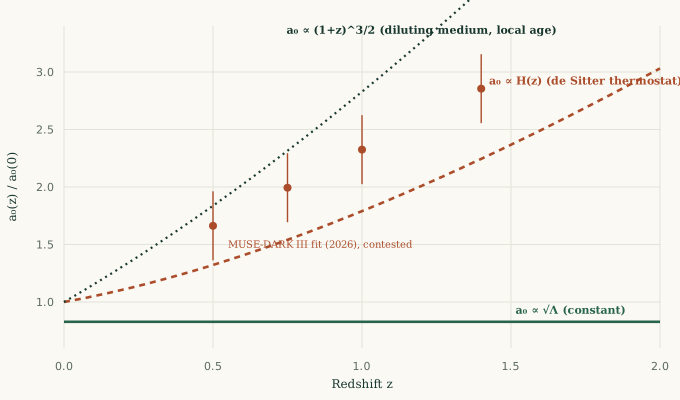
A medium that dilutes with the expansion has n ∝ (1+z)³, hence a₀ ∝ √n ∝ (1+z)3/2. In the matter era H(z) follows the same law, so the “de Sitter thermostat” and “medium density” readings of a₀ coincide, and part ways only in the Λ era, that is now.
Calculation 9
Space, time, and a local clock.
At the level of the substrate, space and time are separate, there is no absolute time, and time can run faster or slower from place to place. The question is what carries that time.
The lattice is space (positions, or neighbour relations) and its dynamics is time; Lorentz symmetry belongs only to the excitations, as in Bell's Lorentzian pedagogy and in Einstein–aether theories. The parameter t of the Hamiltonian is bookkeeping; nothing measures it. The physical time of the medium is its age, the natural clock of a glass: tlocal = ∫dt/τ(x). It stops in an engaged pocket (the vacuum of the Solar System no longer ages), runs at the cosmic rate in a galaxy (marginal, x = 1), and runs faster where the medium is shaken by mergers and tides (rejuvenation). This is the thermal time of Connes and Rovelli applied to a glass: local, with one global tick only, the Λ thermostat, and that tick concerns the medium alone.
Our clocks, however, are not excitations of the lattice (previous section). They read the metric of the continuum, into which the scalar enters through the phantom potential (Φ/c² ~ 10−6 in a galaxy, indistinguishable from a halo) and, in the relativistic completion, through a disformal coupling under which clocks and light read different metrics. That coupling is the only window for a local time beyond general relativity, and it is bounded by the preferred-frame parameters α2 < 10−9 (solar spin) and α1 < 10−4 (pulsars).
A testable form.
If a₀ is set by the local age of the medium (accumulated engagement, a₀ ∝ 1/tlocal), two things follow. With redshift, a₀ ∝ (1+z)3/2, i.e. ×2.3 at z = 0.75, against ×1.5 for the thermostat reading; the contested MUSE-DARK III fit gives ×2.0. And between today's galaxies, all 10 to 12.5 Gyr old, the effect is at most 0.1 dex.
| Age proxy of a galaxy's medium (SPARC, 122 galaxies, a₀ fitted per galaxy) | Slope of log a₀ | 95% interval |
|---|---|---|
| Gas fraction, 0.02 to 0.95 | +0.02 | −0.17 to +0.21 |
| Hubble type, per type | −0.003 | ±0.02 |
| Effective surface brightness, per dex | +0.003 | ±0.07 |
| Gas-dominated subsample (fgas > 0.5, insensitive to the mass-to-light ratio) | median a₀ higher by 0.05 dex | |
No dependence on history at ±0.2 dex. That is compatible with the 0.1 dex expected, so it does not discriminate; it bounds any local acceleration of the medium's time between today's galaxies to a factor 1.6. The real test is a₀(z). In short: “space and time separate” is true of the substrate and false of the excitations; “no absolute time” is true for matter and false for the medium, which has one global tick; “time runs faster locally” is true of the medium's age, whose observable trace is a₀(z).
Corrections
What this page changed on the rest of the site.
- The “occlusion edge” at 0.15–0.3 pc, and a tip back toward MOND beyond itwithdrawn: no calculation supported it; Newtonian at every separation
- “Where a galaxy is diffuse the medium flows”reversed: it is a glassy solid with slack; a fluid carries no static phantom
- “Marginally rigid” everywheremarginal only where it responds; a pocket in 1.7 a₀ must be deep in the solid
- “Acceleration heats it”the element's own acceleration; ambient horizons couple below 10−10 (S2)
- One soft glasstwo components: the tensor sector of general relativity in the continuum, an orientational glass for MOND and memory
- “Gravity as the elasticity of a substrate” (Sakharov, Jacobson, Verlinde)for the anomalous part only; spacetime is not claimed to emerge
- The two conjectures “the horizon is a tear” and “a shell on a torn vacuum”withdrawn the same day, by the spacetime section