Date: December 22, 2025
Source: Sector 7G // Emergent Gravity Archive
Abstract
This document provides a rigorous physical analysis of the transition from atomic to macroscopic scales within the Bath-TT (Emergent Gravity) framework. It addresses how a system of $N$ incoherent atoms inherits the gravitational properties of a single "Ghost" state, specifically through its geometric quadrupole moment.
I. Definition of the "Ghost" State
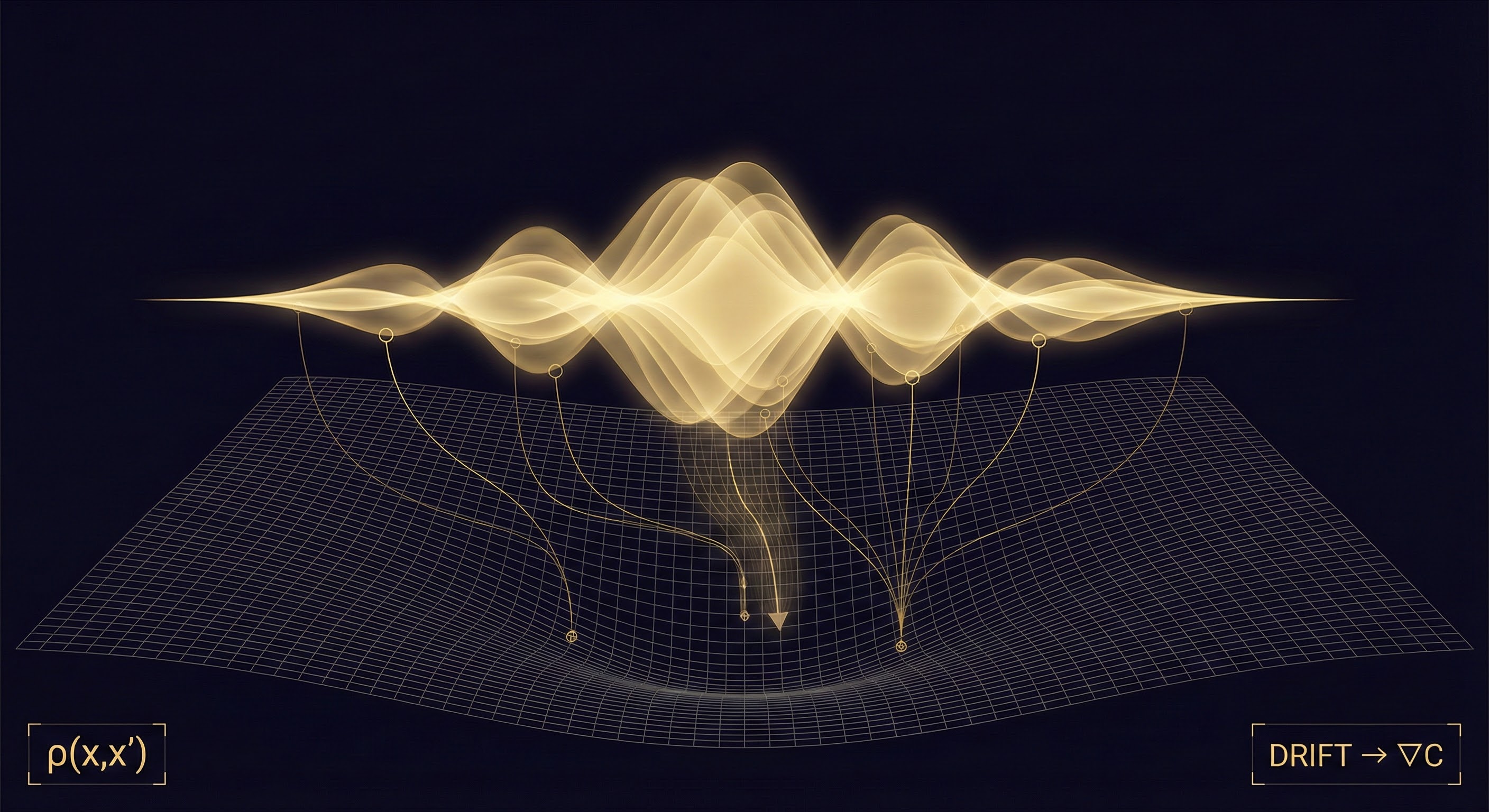
In this formalization, the Ghost is the fundamental, permanent state of matter, defined not as a particle, but as a non-local density matrix $\rho(x, x')$.
II. The Spatially Correlated Bath
The Bath is a reservoir of degrees of freedom characterized by a spatial correlation function $C(r_1, r_2)$.
III. Macroscopic Scaling: From Incoherent Atoms to Rigid Bodies
A macroscopic object (e.g., a pyramid or a rugby ball) consists of $N$ atoms that are mutually incoherent—meaning there is no global phase relation $\langle \psi_i | \psi_j \rangle$ between them due to thermal noise. However, the system still interacts with the Bath as a single unit via two mechanisms:
1. Statistical Summation of Flux
Each individual atom-Ghost maintains its own exchange rate with the Bath. The total Stress-Energy Tensor $T_{\mu\nu}^{\text{macro}}$ is the linear sum of these individual fluxes:
Even without phase coherence, the magnitude of the exchange is additive.
2. Geometric Quadrupole Coupling
While the atoms lack quantum coherence, they possess geometric coherence (rigid positioning). The macroscopic shape—a pyramid or an ellipsoid—defines a global quadrupole moment $Q_{ij}^{\text{shape}}$.
The Bath, due to its spatial correlation, "probes" the density of these exchange sites across the object's volume. An anisotropic shape (like a rugby ball) creates an asymmetric footprint in the Bath's correlation field.
IV. Centroid Drift and Kinematic Constraints
The motion of the object is defined as the Centroid Drift—the shift of the center of amplitude $\langle x \rangle_\rho$ induced by the Bath.
Where $F_k^{\text{Bath}}$ is the "informational pressure" exerted by the Bath's gradient on the individual Ghosts.
V. Inertia vs. Gravitation: The Quadrupole Link
The identity $m_i = m_g$ (Equivalence Principle) is a direct consequence of this coupling:
An object with a high quadrupole moment (like a pyramid) is more sensitive to non-linear gradients in the Bath than a sphere. This is because the $\hat{Q}_{ij}$ operator acts as a geometric antenna, sampling the Bath's correlation at widely separated spatial points.
VI. Summary
| Feature | Physical Description |
|---|---|
| Object State | A collection of $N$ Ghosts, mutually incoherent but geometrically fixed. |
| $\hat{Q}_{ij}$ Function | Maps the object's shape onto the Bath's spatial correlation field. |
| Motion | Resultant acceleration $a_{\text{CM}}$ from the summation of local centroid drifts. |
| Gravity | Emergent flow resulting from the Bath's non-uniform informational density. |