Date: December 22, 2025
Source: Sector 7G // Bath-TT Archive
Abstract
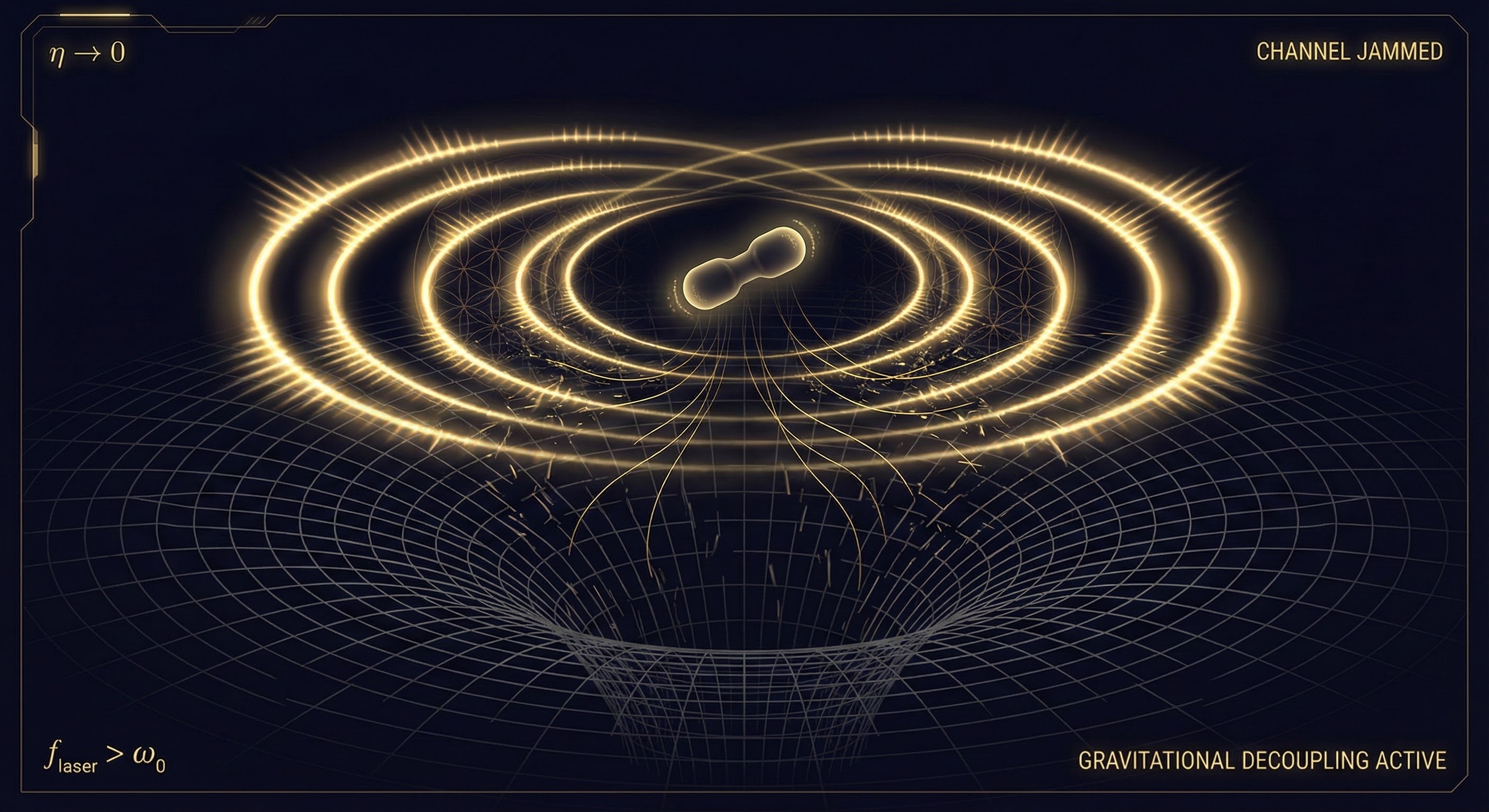
The Emergent Tensor Gravity framework proposes that general relativity arises from the continuous monitoring of matter's quadrupole moment by the vacuum environment ("The Bath"). If gravity is a consequence of environment-induced decoherence, it follows that the coupling strength is frequency-dependent. In this letter, we propose a mechanism to actively suppress this coupling using the Quantum Zeno Effect. We demonstrate that observing a quantum system at a rate $f_{\text{obs}}$ significantly higher than the vacuum's characteristic refresh rate $\omega_0 = c/R$ inhibits the accumulation of the geometric phase required for gravitational interaction. This effectively "jams" the Transverse-Traceless (TT) channel, leading to a state of Gravitational Transparency where the effective gravitational mass $m_g$ vanishes while inertial mass $m_i$ is preserved.
I. Introduction
The "Bath-TT" hypothesis suggests that the Einstein-Hilbert action is not fundamental but an effective field theory emerging from the Lindblad dynamics of open quantum systems. In this view, spacetime geometry is the record of information loss from the system to the vacuum.
Standard matter couples to gravity because the vacuum "measures" its position and orientation, causing decoherence into a classical mixture. However, quantum measurement theory permits a counter-measure: the Quantum Zeno Effect (QZE). It is well established that frequent projective measurements can freeze the evolution of a quantum state.
We hypothesize that if an artificial observation channel dominates the information flow, the natural vacuum channel (gravity) is effectively crowded out. By "over-observing" a system, we can prevent the vacuum from extracting the quadrupole information necessary to generate spacetime curvature.
II. Theoretical Framework
A. The Emergent Gravity Master Equation
Following the Emergent Tensor Gravity derivation, the evolution of the density matrix $\rho$ of a massive object is governed by the Lindblad master equation:
Where $\mathcal{L}_{\text{vac}}$ is the vacuum dissipator responsible for gravity:
Here, $L_k$ are the jump operators corresponding to the coupling with the Transverse-Traceless (TT) vacuum modes. The rate of this gravitational decoherence is given by:
B. The Zeno Suppression Term
We introduce an external, artificial measurement apparatus (e.g., a stroboscopic laser) that measures the system's configuration at a rate $\Omega_{\text{Zeno}}$. This adds a new dissipator $\mathcal{L}_{\text{Zeno}}$ to the dynamics:
Crucially, if the external measurement is projective and stronger than the vacuum coupling ($\Omega_{\text{Zeno}} \gg \Gamma_{\text{TT}}$), the system is constantly projected back into a subspace defined by the external observer.
C. The Decoupling Limit
We define the Gravitational Efficiency $\eta$ as the ratio of information flowing to the vacuum versus the total information leakage. Using the strong-coupling expansion, we find:
As $\Omega_{\text{Zeno}} \to \infty$, we have $\eta \to 0$.
The vacuum cannot "see" the object's quadrupole moment because the state is being reset faster than the vacuum correlation time $\tau_c \approx 1/\omega_0$.
The effective gravitational mass becomes:
This implies that sufficient "information jamming" renders the object transparent to the metric.
III. Proposed Experiment: The "Stroboscopic Dumbbell"
To test this hypothesis, we propose a modification of the "Silent Rotational Interferometer."
Setup
- Subject: A dielectric nanodumbbell ($L = 300$ nm) levitated in a Paul trap
- Control: The dumbbell is prepared in a superposition of orientation states $|\psi\rangle = \alpha|\theta\rangle + \beta|\theta+\delta\rangle$
- The Jammer: A high-intensity, pulsed laser interacts with the dumbbell at frequency $f_{\text{laser}} = 100$ THz
Protocol
- Unlike standard optomechanics, the laser is not continuous
- It acts as a "machine gun" of projective measurements
- The pulses are timed to exceed the "light-crossing frequency" of the object ($\omega_0 = c/L \approx 10^{15}$ Hz)
Prediction
- Without Jamming: The dumbbell emits gravitational information (decoheres) and couples to the Earth's field ($m_g = m$)
- With Jamming: The laser forces the system into a "Zeno Subspace." The vacuum coupling terms average to zero
- Observable: The levitation frequency (trap stiffness) will shift. As $m_g \to 0$, the downward force $F_g = m_g g$ vanishes, while the inertial mass $m_i$ remains constant
The dumbbell will appear to spontaneously rise to the trap's geometric center, ignoring the Earth's gravity.
IV. Discussion: The "Heavy Ghost" Regime
The decoupling of $m_g$ from $m_i$ creates a novel physical state we term the "Heavy Ghost."
V. Conclusion
Gravity is an information channel. Like any channel, it has a finite bandwidth and can be jammed.
By flooding the system with artificial information (measurement), we prevent the vacuum from updating the spacetime geometry.
We conclude that Anti-Gravity is not a propulsion technology, but a cryptographic one: it is the art of hiding mass from the surveillance of the vacuum.
References
[1] Emergent Gravity: From Quantum Decoherence to Spacetime Geometry, Sector 7G Archive, 2025.
[2] Misra, B., & Sudarshan, E. C. G. (1977). The Zeno's paradox in quantum theory. Journal of Mathematical Physics.