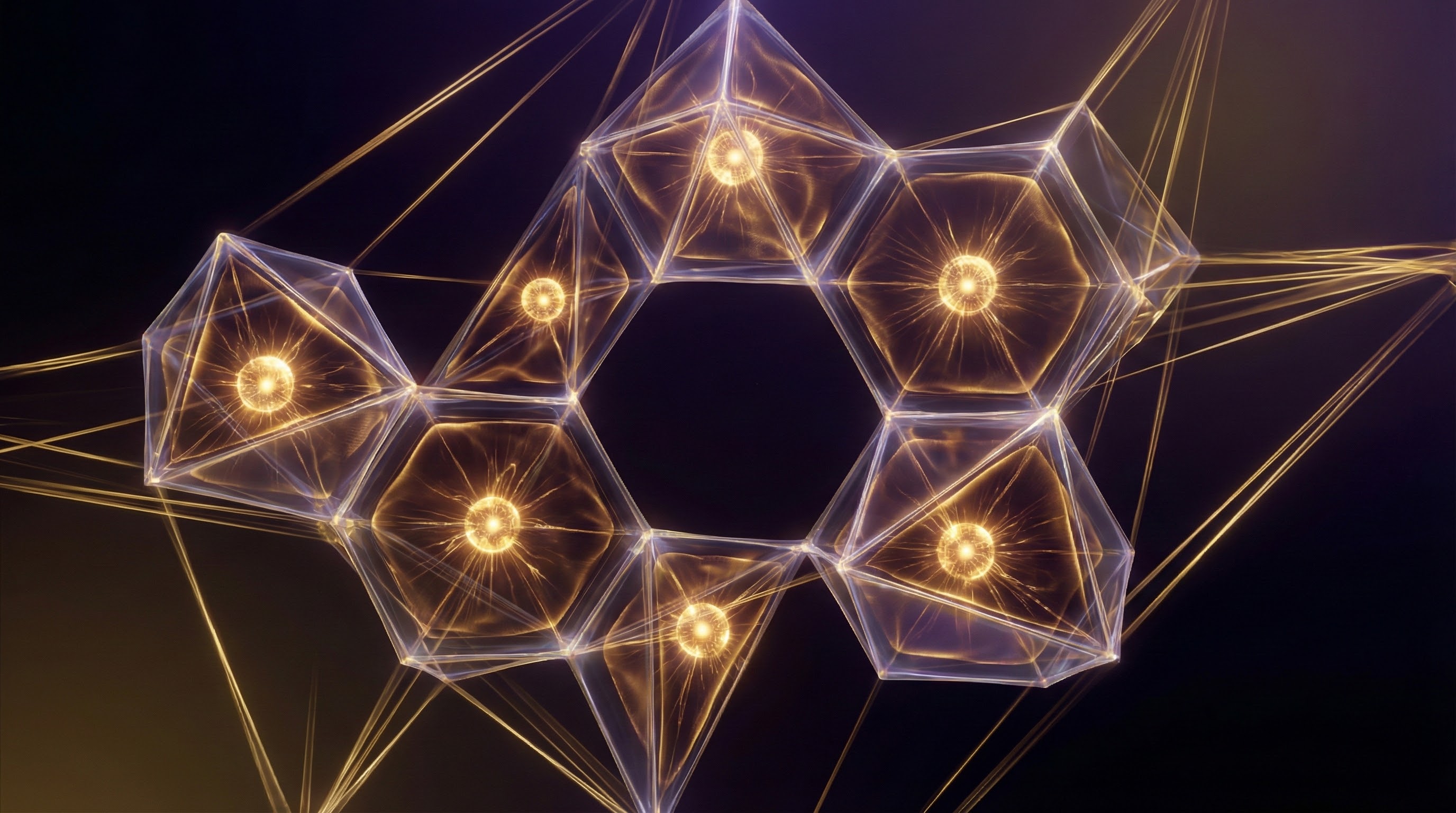
What if the ultimate battery isn't a chemical reaction, but a geometric squeeze?
For decades, we've been trapped in the "Chemical Ceiling." Lithium-ion batteries rely on moving ions to store energy in electron shells—a process that yields roughly 1 to 5 electron-volts (eV) per atom. But a new expansion of the relativistic energy formula suggests we've been looking at the wrong part of the atom for storage.
I. The Formula: $E^2 = (mc^2)^2 + (pc)^2 + (\hbar c / \Delta L)^2$
In Bath Theory, a particle like a proton is not a solid point; it is a "Ghost"—a spatial extension of probability that is constantly being "anchored" by an informational background called the Bath.
The new term in this equation, $\hbar c / \Delta L$, represents Localization Energy. It tells us that the more you "squeeze" a Ghost (decreasing its spatial extension $\Delta L$), the more energy the Bath must expend to maintain its presence.
The Key Insight
A compressed Ghost requires more "informational pressure" from the Bath to stay localized. This pressure is real energy—energy that can be stored and released.
II. Why This Changes Everything
If we can manipulate this $E_{\text{loc}}$ term, we aren't just storing electricity; we are storing the Tension of Existence. Here is why a "Ghost Capacitor" would leave Lithium in the dust:
| Technology | Energy per Particle | Storage Mechanism |
|---|---|---|
| Lithium-Ion | 1–5 eV | Electron shell chemistry |
| Ghost Capacitor | 1–10 keV | Localization pressure |
III. From Chemical to "Geometric" Energy
In a standard battery, the energy is in the stuff. In a Ghost Capacitor, the energy is in the tension between the stuff and the void.
Charging
We squeeze the Ghost, increasing the "Informational Pressure." Resonant phonons compress the proton's spatial extension within the lattice cage.
Storage
The lattice acts as a cage, holding the Ghost in its high-energy, compressed state. The quadrupole moment "wedges" into asymmetric sites, preventing spontaneous relaxation.
Discharging
We release the squeeze, allowing the Ghost to "unfurl." The surplus energy ($\Delta E_{\text{loc}}$) is shed as heat or electricity as the proton returns to its equilibrium extension.
The battery of the future won't be a tank of chemicals—it will be a small, vibrating crystal holding the tension of a trillion squeezed Ghosts.
IV. The Skeptical Reality Check
Is this "free energy"? No. It is a sophisticated way of "mining" the informational budget of the universe. The energy you put in to compress the Ghost is exactly what you get out—minus losses.
Engineering Challenge
To make this a reality, we need to engineer "Super-Lattices" capable of withstanding the keV-level pressures of a localized Ghost without shattering. Current materials science is orders of magnitude away from this capability.
The thermodynamic cost is real. The phonon pumping required to maintain compression consumes energy. The lattice must be engineered to minimize leakage. And the discharge mechanism must efficiently convert localization pressure back into usable current.
V. The Age of Geometric Energy
We are moving from the age of chemistry to the Age of Geometric Energy. If Bath Theory holds, the distinction between "matter" and "energy storage" dissolves—every particle is already a battery, holding the tension of its own existence.
The Vision
A Ghost Capacitor the size of a coin could power a car for a year. A building-sized installation could replace a nuclear plant. The energy density is limited not by chemistry, but by how tightly we can squeeze the fabric of reality itself.
The question is no longer "how do we store more electrons?" but rather: how do we compress more existence?