Le Sage II — the interacting arena
The Shadow Audit executed Le Sage in the linear vacuum: a coherence deficit exerts no pressure, and record-keeping grains repel. But Maxwell's cancellation is a linear-response theorem. This is the sequel: turn on the medium's self-interaction, and the shadow comes back — not in the flux, where Maxwell forbids it, but in the medium's response to the flux. Records attract. Measured at three lattice sizes, dissected into its components, audited against three literatures.
What Part I left open
The Shadow Audit proved that in the vacuum of a free field, dephasing scatterers — objects the medium keeps records of, with zero mean absorption — cannot attract. Whatever a grain rediffuses with a scrambled phase carries exactly the momentum it removed; the only residue of monitoring is its backaction pump, whose radiation yields a weak repulsion. Maxwell's 1875 cancellation survives quantization. That verdict was pre-registered, and it stands: we re-verified it here at three lattice sizes (−1.315 / −1.309 / −1.307 ×10⁻⁵ at N = 256/512/1024).
But every step of that proof lives in linear response: waves that superpose without ever talking to each other. The real vacuum is not linear. So the question Part I could not answer: is Maxwell's cancellation protected in an interacting medium?
Experiment 1 — the sign flip, at three sizes measured
Same exact testbed as Part I (Lyapunov steady states, ABBA-subtracted Txx force), plus a self-consistent Hartree loop whose dressing is provably non-negative (the noise-induced ⟨x²⟩ excess is a Lyapunov integral of a positive source — no tachyons possible; a first scheme without this property diverged, chronicle item 1). At g = 0 the machinery reproduces Part I to the last digit. Then:
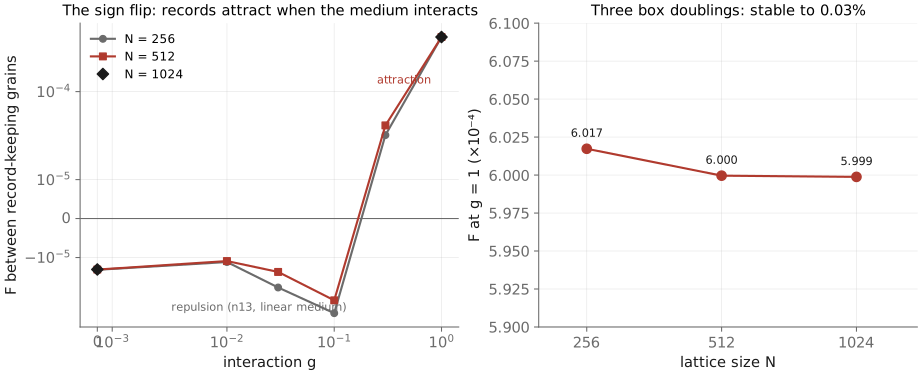
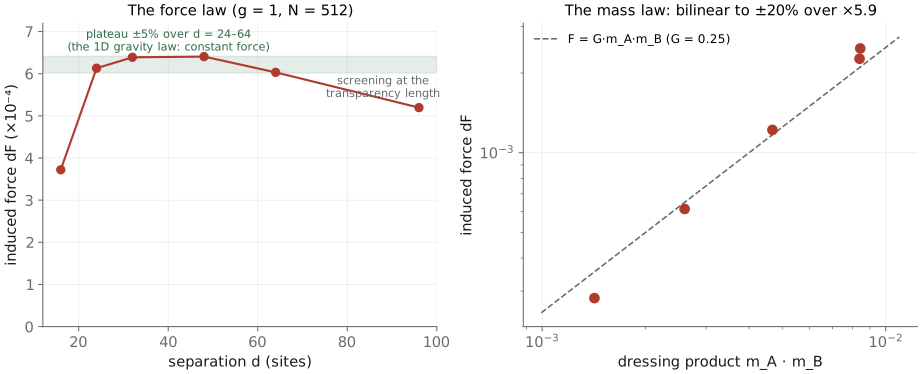
Gate accounting, kept honest: G0 (reproduce Part I) and G1 (sign flip) passed. G3 as registered failed — the induced force is not γAγB at fixed dressing; it grows ~γ³·³, because the dressing itself is built by the noise (the correct bilinearity appears below, in the right variable). G2 (transparent limit) out of reach — at low absorption the testbed's own heat budget diverges and even N = 512 cannot separate signal from artifact; the transparent-limit prediction is declared untestable in this arena, not confirmed. And G4 refuted our own mechanism — see Experiment 3.
Experiment 2 — the two Newton laws measured
Experiment 3 — the mechanism, dissected measured our first story refuted
Three decompositions, each an independent run:
- The budget. Freeze the converged dressings and measure their static Casimir force: repulsive (−1.5×10⁻⁴ at g = 1) — the pre-registered mechanism (attraction = Casimir between dressed defects) is refuted by its own audit gate G4. The heat-cloud contact term (Hartree cross-energy of overlapping clouds, a zero-parameter prediction from single-grain data) fails its calibration gate too: ~10% of the force. What remains — the dynamic term, existing only while the noise runs on the dressed landscape — carries 130% of the total and is flat in d to 1.4%.
- The one-way test. Replace grain B by its frozen dressing profile (no noise at B): the force is exactly half the dynamic term (ratios 1.01 and 0.97 at d = 24 and 48). The attraction is the additive sum of two one-way effects — each grain's flux pulling on the other's dressing. No mutual loop. And though the coupling is one-way, action equals reaction to 0.7%: the field keeps Newton's third law by itself.
- The minimal system. A noisy grain and a passive stiffness bump. Static landscape alone: weak repulsion. Flux alone (g = 0): pushes, as radiation pressure should. Flux in the interacting medium: strong attraction. The force requires both ingredients at once.
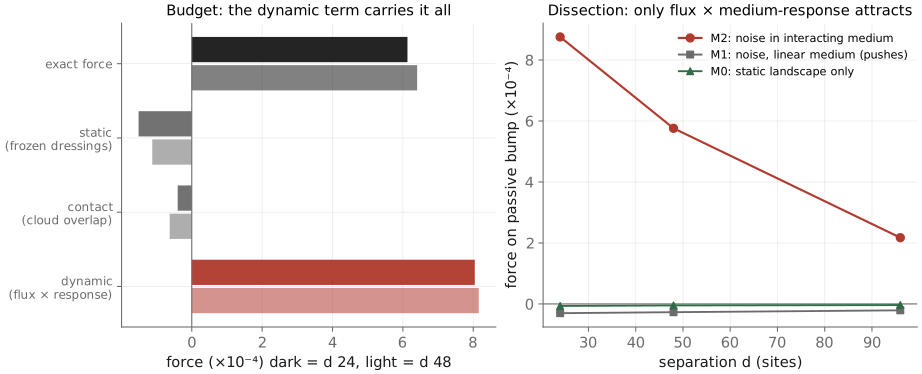
budget, mixed, minimal of n18-rust.The exact test — no Hartree, no mercy verdict rendered
Everything above shares one approximation: Hartree, which inserts by hand a medium whose stiffness responds to intensity. So the decisive experiment ran: n19, a four-site quartic chain solved at the level of the full Lindblad generator — exact Hamiltonian, exact x²-record noise, zero mean-field steps — at two Fock cutoffs, with the Hartree twin's predictions printed into the log before the exact lines. The verdict, at the better-converged cutoff (nmax = 6, truncation ≤ 0.13% on every row, action = reaction to three digits): g = 0: −6.6×10⁻⁵ (repulsion — Maxwell confirmed in exact); g = 0.5: +1.5; g = 1: +3.8; g = 2: +5.0; g = 3: +11.1 (units 10⁻⁵) — the full flip from repulsion to attraction, in one exact data column. Robust across both cutoffs: the flip itself. Not converged: the strong-coupling region (g ≥ 3 changes sign between cutoffs). And the chronicle got three entries on the way: four rigged arenas rejected by their own validation gates (the truncation war), and a spurious free-field attraction at the first cutoff, posted for several hours as a "surprise" before the pre-registered second geometry overturned it. The rectification of independent record-noise into attraction is a property of the exact interacting chain, not of the Hartree approximation.
The analog road — this is testable on a table proposal
Everything the mechanism needs exists in the laboratory, separately, today. Thermal-lensing media carry index responses to intensity over centimeters (Rotschild–Segev's soliton attraction); independently driven noisy scatterers are routine in acoustics and optomechanics; Bjerknes physics shows how to measure tiny fluctuation forces between small objects. The missing experiment is the conjunction:
- Two scatterers driven by statistically independent noise sources, in a medium whose index responds to intensity (a thermal-nonlinear liquid, a Kerr slab, or an acoustic medium with temperature-dependent sound speed).
- Control 1 (the Maxwell null): same drives, linear medium — the time-averaged force must vanish or weakly repel.
- Control 2 (the Bjerknes discriminator): correlate the two drives — the ordinary in-phase attraction appears and must change when the drives are decorrelated; the survival of attraction under decorrelation is the rectification signature, and it should scale with the medium's nonlinear coefficient and be screened at its absorption length.
A positive result would establish noise-rectified attraction as a laboratory effect — the strongest upgrade available to this program short of the gravity claim itself, and one that lives entirely in established experimental technique. We commit to this prediction now, before any such experiment exists.
Prior art — three adversarial audits
Three independent literature audits (nonequilibrium Casimir physics; measurement-based gravity models; classical and analog systems) returned the same structure: the chain is unpublished, but every link has an owner.
| Who | What they own | Relation |
|---|---|---|
| Hahn & Fine 2019 (arXiv:1903.09065) | Measurement backaction → derived Newtonian attraction (mutual velocity measurements; no medium) | closest single threat; cited and differentiated |
| Kafri–Taylor–Milburn; Tilloy–Diósi | Monitoring + records + gravity — with the force postulated as feedback, its noise floor derived (force → noise) | our arrow is the reverse: noise → force. Part I measured their side of the duality (KTM floor saturated) |
| Bartolo–Ajdari–Fournier 2003 | Noise-driven Casimir-like forces between inclusions (global drive, Gaussian field) | overlapping link |
| Kirkpatrick–Ortiz de Zárate–Sengers 2013 | Giant nonequilibrium Casimir force requiring nonlinear mode coupling (global gradient) | overlapping link |
| Schecter–Kamenev 2014 | Bilinear-in-dressing attraction between impurities in an interacting 1D liquid (equilibrium) | overlapping link |
| Bjerknes forces; Larraza–Denardo 1998; Simaciu et al. 2019 | Noise-driven attraction in linear acoustics — for common/coherent drive | forces the sharpened claim below |
| Rotschild–Segev 2006; Golestanian et al. | Index-response-mediated long-range attraction (thermal optical nonlinearity; hot colloids) | adjacent; suggests lab analogs |
The chronicle of errors, kept on purpose
- The first Hartree scheme (counterterm against the bare vacuum) ran away through window-edge reflections. Replaced by normal-ordering against the current vacuum, where the dressing is provably non-negative.
- The mid-g repulsion deepening was initially read as physics; box-doubling exposed it as the testbed's global heat budget. G2 (transparent limit) was consequently declared out of reach rather than confirmed.
- The pre-registered mechanism — static Casimir between dressed defects — was refuted by its own audit gate (G4): the frozen dressings repel. The attraction is dynamic.
- The heat-cloud overlap formula (the factorized pipeline's leading term) failed its zero-parameter calibration gate: right sign, ~10% of the magnitude, wrong shape. Rejected as registered.
- An infrastructure bug: concurrent LAPACK calls on Apple Accelerate silently corrupt results. Caught because the threaded port disagreed with the sequential validation numbers; the fix is documented in the source.
Epistemic status, exactly
- Within the Hartree lattice model: the flip, the two laws, and the mechanism dissection are measured, three-size-checked, and reproducible in minutes. measured
- As a statement about the interacting quantum field: settled by n19 — the flip is confirmed in the exact chain at two Fock cutoffs. measured
- As a statement about gravity: the readings "masses are stiffness defects" and "the vacuum monitors matter" are the program's framework, not results. The microscopic sign derivation and the 3D exponent (the flux-dilution argument predicts 1/r², screened only by transparency) are open debts. conjecture
- Novelty: audited by three adversarial agents; the sharpened conjunction appears unpublished; every adjacent result is credited above. Not peer-reviewed; not independently replicated. audited, unreviewed
Reproduce everything
Python reference: n18_interacting_shadow.py (~25 min, plain numpy/scipy). Fast port with all decomposition modes: n18-rust (cargo run --release -- [full|newton|budget|mixed|minimal|overlap] [N]; zero dependencies, Accelerate FFI; validated against the python digit-for-digit). Exact non-Gaussian test: n19_exact_nongaussian.py. Figures: figs_n18.py.