The Shadow Audit
Le Sage's 1748 push-gravity, rebuilt on the quantum vacuum, repaired with the best mechanism we could construct — then executed by its own pre-registered kill-gate. Three experiments, two refutations, one bound saturated. The corpse turned out to be worth more than the theory.
The exercise
Georges-Louis Le Sage (1748) proposed that gravity is a shadow: space is filled with an isotropic flux of corpuscles, every mass absorbs a little of it, and two masses shield each other — the pressure imbalance pushes them together. The theory dies classically on two theorems. Poincaré: the absorbed flux needed for gravity-strength forces vaporizes the Earth in seconds. Maxwell: make the corpuscles elastic to evade the heating and the force vanishes identically — whatever a scatterer re-emits refills the shadow exactly.
As an exercise, we rebuilt Le Sage with the quantum vacuum in place of corpuscles: a Planck-cutoff bath (the Lorentz-invariant ω³ spectrum), opacity κ = ℓ²Pl/mPl, multiplicative shadow composition, clocks that tick at the local mode density. The construction goes surprisingly far — an exponential (Yilmaz-type) metric passing all solar-system tests at 2PN, a tensor radiative sector compatible with LIGO polarizations and Hulse–Taylor, no horizons, a structurally absent cosmological-constant problem, a nine-entry registry of pre-registered predictions, and one real-data test (the two RXTE quasi-periodic-oscillation triplets, fit as well as Kerr: χ² 0.33 vs 0.11). It also contains real rot: the "derivation" of G from Planck units is a dimensional tautology; the light-deflection factor 2 is imported by a postulate, not produced by the mechanism; two registry predictions were already dead in the published literature (Eöt-Wash torsion bounds; the Gran Sasso X-ray bound on parameter-free Diósi–Penrose collapse). All of that is recorded. What matters here is the load-bearing question the exercise finally reduced to.
This is a sharp, computable claim. We pre-registered the test and built it.
Experiment 1 — the kill-gate: dephasing does not attract refuted
A 1D scalar lattice vacuum, exact steady states by Lyapunov equations (no Monte Carlo, no transients; the boundary bath is built so the undriven steady state reproduces the exact ground state to 7×10⁻¹³). Two "Le Sage grains": fluctuating-index scatterers coupled to the local field strain — they scatter modes elastically with a random phase, creating records without mean absorption. Force read from the momentum-flux (Txx) discontinuity across each grain, with a four-configuration ABBA subtraction. The method was validated first: on static (coherent) defects the same observable reproduces the exact Casimir force −dE₀/dd to 0.5–1% across all separations; a single noisy grain shows zero parasitic force to one part in 10⁷.
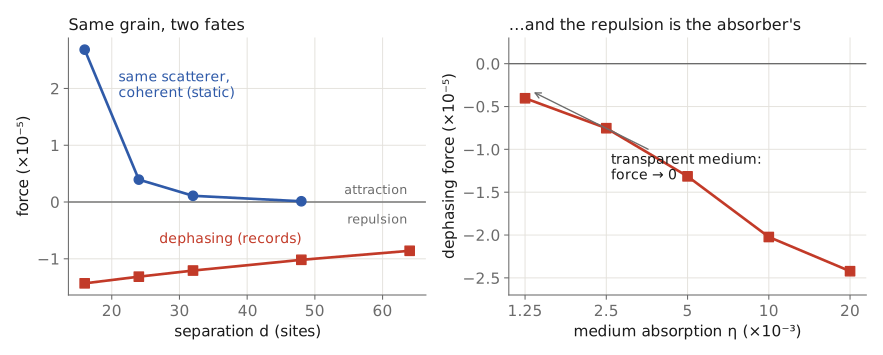
Maxwell's theorem survives quantization and decoherence. The wave a grain rediffuses with a scrambled phase carries exactly the momentum it removed from the beam; a coherence deficit exerts no pressure. The only real effect of dephasing at T=0 is its unavoidable backaction — parametric pumping, whose radiation, absorbed by the medium, supplies the small repulsion. Decoherence does not create the attraction. It destroys it: the coherent version of the same grain attracts, and adding records kills that force. The repair — and with it every Le Sage, classical or quantum — fails its own gate. Caveats as registered: 1D, Gaussian, white noise, two coupling choices tested (both agree); Maxwell's argument is dimension-blind.
Experiment 2 — what monitoring can do: the classical channel, priced measured
The same testbed answers the successor question. If decoherence cannot create the force, can it carry one created by a real coupling — classically, with no entanglement? Two quantum masses (slow, below the field band: the adiabatic regime, which is the gravity regime — sources slower than the medium), coupled linearly to the field, delocalized à la Bose–Marletto–Vedral (x-squeezed, spread ×55). The vacuum "keeps records": local dephasing at rate κ on the channel region.
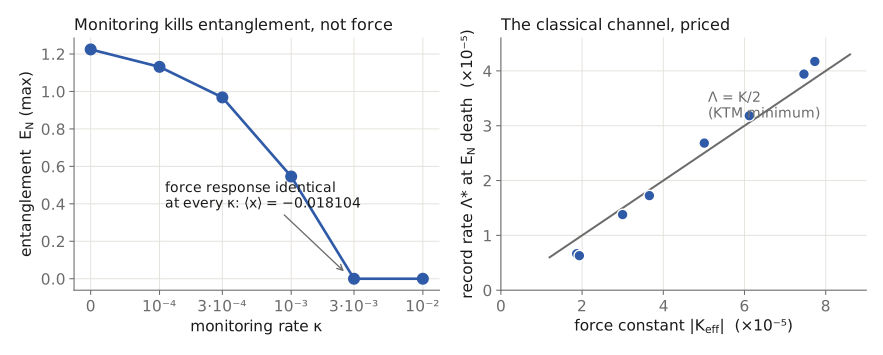
Translated to real units (K = 2Gm²/d³), that floor is the regularized Diósi–Penrose decoherence rate. The triplet {Newtonian force intact, zero BMV entanglement, decoherence at the DP floor} is therefore not three predictions but one channel theorem — demonstrated here end-to-end in an extended field with real propagation, apparently for the first time at this level of explicitness. This is the quantitative content of the classical branch of the BMV fork.
Experiment 3 — the record resolution is structurally free measured
One parameter remained possibly derivable: R₀, the spatial resolution of the vacuum's records — the constant the real-world experimental corridor (below: Gran Sasso spontaneous-radiation bounds; above: Eöt-Wash short-range gravity) takes in a pincer. Hypothesis, pre-registered with both outcomes: the lazy vacuum — the resolution that minimizes heating at fixed classicality — selects R₀. We replaced pointwise monitoring with Gaussian probes of width R, bisected the classicality threshold κ*(R) for each width, and measured the masses' heating there.
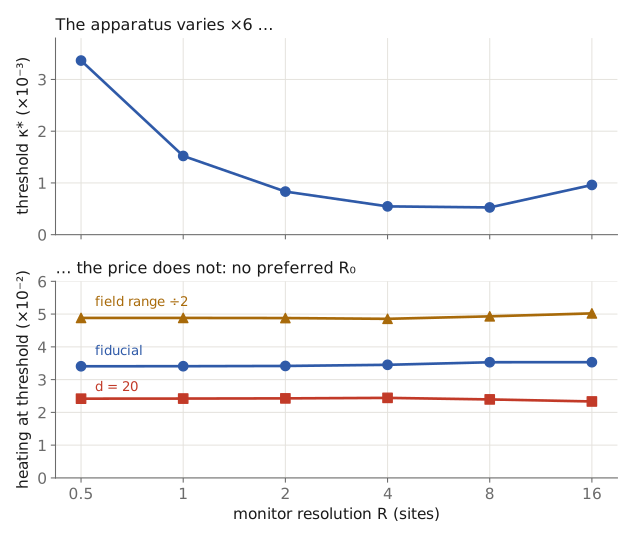
Two consequences. R₀ cannot be derived by economy: it is a genuinely free parameter of the classical-channel class — an honest negative that promotes "R₀ measured, not derived" from an open task to a structural fact. And the flip side is good news: the source-heating floor is apparatus-independent, fixed by K/2 alone, so the radiation experiments probing the corridor test the bound itself, not a modeling choice.
What survives: the corridor
Le Sage is dead, but the audit leaves a live, falsifiable residue that belongs to the whole classical-channel class (Kafri–Taylor–Milburn, Tilloy–Diósi — the class this repair collapsed into once made consistent):
- BMV must give strictly zero entanglement, while the force is exactly intact — the two halves were demonstrated together above. toy-demonstrated
- Gravitational decoherence at the DP floor, Λ = K/2ℏ — now derived as the saturation of a bound, not assumed. toy-demonstrated
- R₀ lives in a closing corridor: ≥ 0.54 Å (Gran Sasso underground X-ray bound, which already killed the parameter-free DP model) and ≲ 40 μm (Eöt-Wash Newtonian gravity). Radiation experiments push up, short-range gravity pushes down, levitated-superposition experiments probe the middle — with verdicts expected within a decade. the live prediction
And the audit sharpens the main program's fork. The monogamy book treats gravity as a quantum channel — entanglement bookkeeping, BMV positive. The classical-channel book, priced here, predicts BMV null plus DP-floor decoherence. The same experiment closes one of the two books. That is what a fork should look like.
The chronicle of errors, kept on purpose
- The "no free parameters" derivation of G was a dimensional tautology — Planck units are defined from G. Caught in review, recorded, no longer claimed.
- Two registry predictions were pre-falsified by published data we had not checked (Eöt-Wash; Gran Sasso). A prediction registry without a literature audit of existing constraints is theater.
- The coherence-shadow repair was proposed with confidence and a mechanism that sounded derivational. Its own pre-registered kill-gate refuted it in an afternoon of numpy. The prosecutor and the defense were the same model; only the computation broke the tie.
- The first dephasing result (site-coupled grains) was dominated by a lattice band-edge artifact — caught because the η-scan was part of the protocol, fixed by coupling to the strain.
- The first channel experiment put the masses above the field band; the mediated channel is then evanescent and no entanglement flows. The gravity regime is the opposite corner — slow sources, fast medium. A wrong result that taught the right regime.
Reproduce everything
Three scripts, plain numpy/scipy, exact linear-algebra methods (Lyapunov steady states, generator diagonalization — no Monte Carlo anywhere): n13_dephasing_shadow.py (~1 min), n14_classical_channel.py (~2 min), n15_record_resolution.py (~10 min). Every figure and number on this page comes from them. The standalone note, written for readers from the collapse-model and gravitational-decoherence communities (zero emergent-gravity claims, pure open-quantum-systems content): PDF, 7 pages.