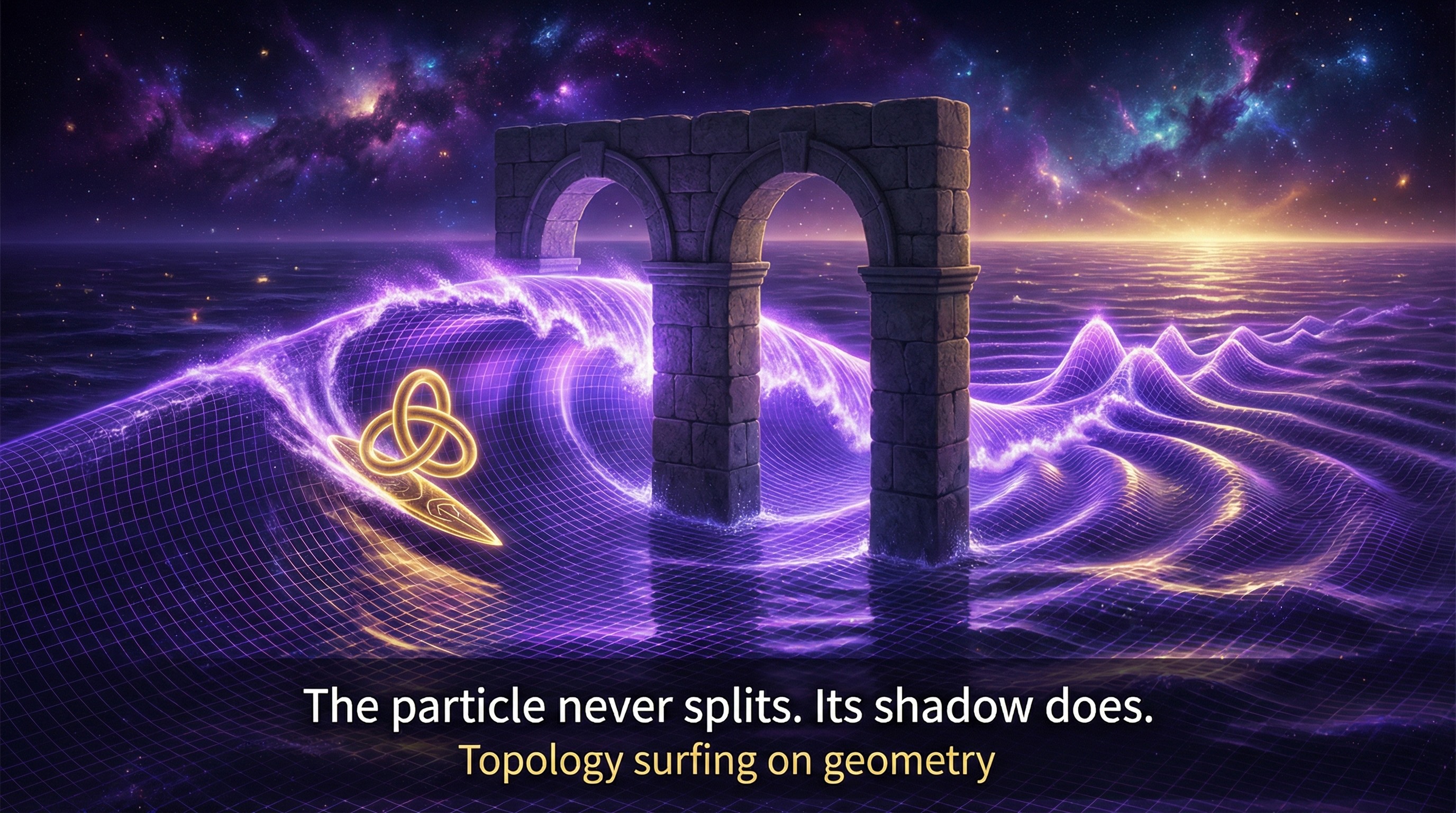
"The electron does not split. It paints its own path, and the paint interferes."
Abstract
For a century, the Double Slit experiment has been presented as proof that electrons are "wave-particles" — ghostly entities that pass through both slits simultaneously and interfere with themselves.
This interpretation is unnecessary. Stochastic Electrodynamics (SED) — a classical theory developed by Boyer, de la Peña, and Cetto — provides a complete explanation: the electron is always a particle, passing through one slit. But it carries an internal clock, and by moving through the Zero Point Field, it selects an electromagnetic wave at its de Broglie wavelength.
The electron paints its own interference pattern. The wave is real, electromagnetic, and created dynamically by the electron's motion — not pre-existing in the vacuum.
In Entry 026, we saw that Hilbert space is the spectral limit of a discrete graph. In Entry 024, we derived Newton's gravity from holographic entropy.
Now we complete the triangle. The same Bath that produces gravity also produces quantum interference. There is no "quantum weirdness." There is only the vacuum, and we forgot it was there.
I. Stochastic Electrodynamics: The Forgotten Theory
In the 1960s and 70s, a small group of physicists — Timothy Boyer, Luis de la Peña, Ana María Cetto, Trevor Marshall — developed a radical alternative to quantum mechanics.
Their idea was simple: What if the vacuum is not empty?
Quantum Electrodynamics (QED) had already established that even at absolute zero, electromagnetic fluctuations pervade all of space. This is the Zero Point Field (ZPF). The energy density is:
This is not speculative. It is the standard QED prediction, confirmed experimentally via the Casimir effect, the Lamb shift, and spontaneous emission.
The SED insight was to take this field seriously as a classical random electromagnetic background. A charged particle immersed in this field experiences random kicks — a kind of electromagnetic Brownian motion.
The Zero Point Field is a real, classical, Lorentz-invariant random electromagnetic field that pervades all of space.
Charged particles (electrons, protons) are classical point charges that interact with this field according to Maxwell's equations.
Quantum behavior emerges from the stochastic dynamics of classical particles in this fluctuating background.
1.1 The Abraham-Lorentz-Dirac Equation
The equation of motion for a classical electron in the ZPF is:
where $\tau = 2e^2/(3mc^3) \approx 6.3 \times 10^{-24}$ s is the radiation reaction time, and $\mathbf{E}_{ZPF}, \mathbf{B}_{ZPF}$ are the fluctuating vacuum fields.
This is a stochastic differential equation. The electron's trajectory is not deterministic — it performs a random walk driven by the vacuum fluctuations.
II. The Electron's Internal Clock
The first key insight of modern SED is that the electron has an internal oscillation.
An electron immersed in the ZPF is constantly being shaken. Due to the relativistic non-linearities in the equation of motion, this shaking is not random — it organizes into a coherent oscillation at a characteristic frequency:
This is the Zitterbewegung (German: "trembling motion"), first predicted by Schrödinger in 1930. In orthodox quantum mechanics, it is a curious mathematical artifact. In SED, it is physical: the electron literally vibrates at this frequency.
The electron is not just emitting energy (which would cause it to spiral down). It is in thermodynamic equilibrium with the ZPF: absorbing energy from the vacuum and re-emitting it at the same rate.
The "field of the electron" is not just its static Coulomb field. It is the local perturbation of the ZPF maintained by this constant exchange. The electron is like a standing wave in the vacuum noise.
This internal clock is the key. It does not depend on the electron's velocity — $\omega_0$ is intrinsic, determined only by the electron's mass. But when the electron moves, something remarkable happens.
III. The Doppler Selection Mechanism
Here is where de Broglie's wave emerges — not as a postulate, but as a consequence of special relativity.
3.1 The Problem with Static Patterns
A naive interpretation of SED might suggest that the ZPF has an interference pattern "pre-sculpted" by the slits, and the electron just follows it.
The ZPF contains all frequencies (spectrum $\propto \omega^3$). Each frequency would create an interference pattern with a different fringe spacing. Summing over all frequencies gives... uniform noise.
Worse: how would the vacuum "know" the electron's velocity in advance? A fast electron produces tight fringes ($\lambda_{dB} = h/p$ is small). A slow electron produces wide fringes. The vacuum cannot anticipate this.
The static pattern interpretation fails. The mechanism must be dynamic.
3.2 The Resonance Condition
The electron oscillates at $\omega_0$ in its own rest frame. To remain in radiative equilibrium (absorbing and emitting at the same rate), it must couple to ZPF modes that stay in phase with its internal clock.
But the electron is moving at velocity $v$. From the lab frame, the ZPF modes are Doppler-shifted. Only a specific subset of modes — those that, after Doppler correction, match $\omega_0$ — can maintain resonance.
For the electron to stay in phase with a ZPF wave while moving at velocity $v$, the wave must have a phase velocity:
$V_\phi = \frac{c^2}{v}$
This is a standard result of special relativity: particle velocity × phase velocity = $c^2$.
The electron's energy in the lab frame is $E = \gamma m_e c^2$. The corresponding frequency is:
$\nu_{lab} = \frac{E}{h} = \frac{\gamma m_e c^2}{h}$
The wavelength of the resonant wave is:
$\lambda = \frac{V_\phi}{\nu_{lab}} = \frac{c^2/v}{\gamma m_e c^2/h} = \frac{h}{\gamma m_e v}$
But the relativistic momentum is $p = \gamma m_e v$. Therefore:
$\lambda = \frac{h}{p} = \lambda_{dB}$
It is the wavelength of the ZPF mode that remains in resonance
with the electron's internal clock during motion.
IV. The Interference Mechanism
Now we can explain the Double Slit correctly.
4.1 The Electron Paints Its Wake
The electron approaches the barrier with momentum $p$. It is oscillating internally at $\omega_0$, and this oscillation couples to a specific ZPF mode with wavelength $\lambda_{dB} = h/p$.
This is not an abstract "probability wave." It is a real electromagnetic wave — a coherent perturbation of the ZPF, organized by the electron's motion.
Think of a boat moving across a lake. The boat creates a wake — a pattern of waves that travels with it. The wake depends on the boat's speed: faster boats create tighter, more V-shaped wakes.
Similarly, the electron creates an electromagnetic "wake" in the ZPF. The wavelength of this wake is $\lambda_{dB}$. It is not pre-existing; it is generated by the electron's motion.
4.2 The Wave Passes Through Both Slits
The electron passes through one slit. It is a particle; it does not split.
But the electromagnetic wave — the organized perturbation of the ZPF — is not confined to the electron's location. It propagates outward. It passes through both slits.
Behind the barrier, the waves from both slits interfere. This is ordinary wave optics — nothing quantum about it. The interference pattern has fringe spacing:
4.3 The Electron is Guided
The electron, after passing through its slit, continues toward the screen. But it is not free — it is coupled to the ZPF, and the ZPF now has interference structure.
Via the Lorentz force, the electron feels the local electromagnetic field. Where the interference is constructive (high field intensity), the electron experiences stronger forces. Where it is destructive (low field), weaker forces.
Statistically, over many trials, electrons are pushed toward the maxima of the interference pattern. The probability distribution matches the wave intensity:
The electron does not interfere with itself. Its wake interferes. The electron then surfs the interference pattern it created.
V. The Couder Vindication
In 2006, Yves Couder and Emmanuel Fort at the University of Paris performed a stunning experiment that demonstrates this exact mechanism macroscopically.
They created millimeter-scale oil droplets bouncing on a vibrating bath of silicone oil. Each droplet, upon bouncing, generates waves in the bath. As it moves, it surfs on the waves it created previously.
When these "walkers" were sent through a double-slit barrier, they produced interference patterns — statistically identical to the quantum prediction.
Each droplet passed through exactly one slit. The wave field passed through both. The droplet was guided by waves it created itself.
The system also reproduced: quantized orbits, tunneling, and uncertainty-like behavior. All classical. All deterministic (given initial conditions).
The Couder experiments are a macroscopic proof-of-concept for the SED mechanism:
| Property | Couder System | SED System |
|---|---|---|
| Particle | Oil droplet (~1 mm) | Electron (~10⁻¹⁵ m) |
| Wave medium | Silicone oil bath | Zero Point Field |
| Internal clock | Bouncing frequency (~80 Hz) | Zitterbewegung (~10²¹ Hz) |
| Wave source | Droplet impact creates waves | Electron oscillation organizes ZPF |
| Wavelength | Set by bath vibration frequency | $\lambda_{dB} = h/p$ |
| Interference | Bath waves through both slits | ZPF perturbation through both slits |
VI. SED vs. Pilot Wave (Bohm)
This mechanism sounds similar to de Broglie-Bohm pilot wave theory. The difference is ontological.
| Property | Bohmian Mechanics | SED |
|---|---|---|
| Nature of wave | $\Psi$ is a fundamental entity, distinct from matter and energy | The wave is electromagnetic (real $E$ and $B$ fields) |
| Origin | The wave exists fundamentally, guiding the particle | The wave is emergent, organized by the particle's motion |
| Schrödinger equation | Postulated as fundamental | Derived statistically from Newton + Maxwell + ZPF |
| Without particle | The wave still exists | No particle → no organized wave, just noise |
Bohm: An invisible rail (the wave $\Psi$) guides a train (the electron). The rail exists even without the train.
SED: A hovercraft on a choppy sea. The hovercraft creates a bow wave as it moves. The wave interferes with obstacles (slits). The hovercraft then rides its own interference pattern. Remove the hovercraft → just random chop, no guiding pattern.
VII. The "Collapse" Demystified
If you detect which slit the electron passed through, the interference pattern disappears. Copenhagen says this is "wavefunction collapse."
In SED, the explanation is mechanical:
To detect the electron at slit A, you must interact with it — shine a photon, create a magnetic field, etc. This interaction injects additional electromagnetic noise into the system.
The electron's internal clock is perturbed by the detection interaction. The phase relationship between the electron's oscillation and its wake is disrupted.
The wave emanating from slit A (where detection occurred) is no longer phase-coherent with what would have come from slit B. The detector has "randomized" the phase.
Without phase coherence, there is no interference. Just two overlapping blobs.
We didn't collapse reality. We scrambled the electron's internal clock.
7.1 The Quantum Eraser
In "quantum eraser" experiments, interference can be restored by post-selecting events where the which-path information is "erased."
The detector interaction randomizes phase, but this randomization is correlated with detector outcomes. By selecting only those events where the detector outcome was "null" (no phase kick), you filter for trials where coherence was preserved.
You're not erasing information or changing the past. You're filtering for the subset of events where the electron's clock wasn't disturbed.
VIII. The Bath Connection
Here we must be explicit about something that is often left implicit:
Not an analogy. Not a correspondence.
The same physical entity.
In Entry 024, we derived Newton's gravity from holographic entropy. The key ingredient was the Bath — a sea of thermal fluctuations at the Planck scale that pervades all of space.
In SED, physicists call it the Zero Point Field — the electromagnetic fluctuations that persist even at absolute zero.
These are not two different things. They are two names for the same substrate, discovered from different directions:
The Gravity Path
Bekenstein-Hawking entropy → Holographic principle → Information at boundaries → Bath fluctuations → Entropic force → Gravity
The Quantum Path
QED vacuum energy → Casimir effect → Zero Point Field → Stochastic dynamics → Doppler resonance → Interference
Both paths lead to the same ocean. We just gave it different names depending on which shore we started from.
Gravity and Quantum Interference are two faces of the same phenomenon.
At the microscopic scale: A single electron's Zitterbewegung organizes a coherent wave in the Bath. This wave passes through slits and interferes. The electron surfs its own wake. We call this quantum behavior.
At the macroscopic scale: Many particles (locked voxels) create a persistent shadow in the Bath — a region of reduced fluctuation pressure. Other matter drifts toward this shadow. We call this gravity.
The mechanism is identical: matter follows gradients in the Bath. The electron follows the gradient of its own wake. The apple follows the gradient carved by Earth. Same physics, different scales.
8.1 Why This Matters
If the ZPF and the Bath are the same thing, then:
1. Quantum mechanics is not fundamental. It is the statistical mechanics of particles in the Bath, just as thermodynamics is the statistical mechanics of molecules in a gas.
2. Gravity is not fundamental. It is an entropic force arising from the same Bath, just as osmotic pressure arises from concentration gradients.
3. The "quantum-gravity gap" dissolves. There is no gap. Both phenomena emerge from the same substrate. The difficulty of unification was a category error — we were trying to unify two shadows, not realizing they came from the same light.
4. The measurement problem has a physical answer. "Collapse" is decoherence — the scrambling of phase relationships by Bath noise. Nothing magical. Just thermodynamics.
8.2 The $6\pi^5$ Bridge
In Entry 022, we showed that the proton-electron mass ratio is $6\pi^5$ — a topological invariant encoding the information content of a voxel knot.
This ratio determines how particles couple to the Bath:
The electron, with its slow clock, resonates with long-wavelength Bath modes. It is easily pushed around by vacuum fluctuations — hence "quantum."
The proton, with its fast clock, resonates with short-wavelength modes. It is harder to deflect, more "classical." But it still couples to the Bath — it still feels gravity.
The $6\pi^5$ ratio is not arbitrary. It is the ratio of topological complexity between the two particles, and it determines their relative "quantum-ness."
IX. Testable Predictions
SED makes predictions that differ from orthodox quantum mechanics:
| Effect | SED Prediction | Orthodox QM | Magnitude |
|---|---|---|---|
| Temperature dependence | Fringe contrast decreases at higher T (thermal noise disrupts clock phase) | No temperature dependence | $\delta C / C \sim k_B T / \hbar\omega_0 \sim 10^{-5}$ at 300K |
| External EM field | Static E or B field perturbs Zitterbewegung → shifts pattern | Only Aharonov-Bohm phase shift | Depends on field strength vs. ZPF amplitude |
| Particle mass dependence | Heavier particles have faster clocks → narrower resonance → sharper fringes | All particles obey same $\lambda = h/p$ | Second-order corrections in $m$ |
| Near Casimir plates | Modified ZPF spectrum → modified interference | No effect on quantum behavior | $\delta\lambda / \lambda \sim (d/\lambda)^{-4}$ for plate gap $d$ |
These effects are small but nonzero in SED and exactly zero in QM. Precision experiments could distinguish between the theories.
X. The Honest Limitations
SED is not a complete theory. We must acknowledge its open problems:
1. The Hydrogen Atom: SED correctly predicts the ground state, but struggles with the full spectrum of excited states. The 1/r potential creates mathematical difficulties (caustics in stochastic trajectories).
2. Spin: Classical SED has no natural explanation for spin-1/2 statistics. Extensions exist but are not fully satisfactory.
3. Entanglement: Bell inequality violations require correlated ZPF modes at spacelike separations. The mechanism exists in principle (the ZPF is a single correlated field) but has not been derived rigorously.
4. Quantitative calculations: Showing explicitly that the Lorentz force from the interfering wake produces exactly the $\cos^2$ distribution is a difficult calculation, done only approximately.
These are not reasons to dismiss SED. They are research directions. Orthodox QM also took decades to resolve its foundational puzzles.
XI. Conclusion
The electron is not schizophrenic. It does not pass through both slits. It does not interfere with itself. It does not "collapse" when observed.
The electron is a particle with an internal clock. By moving through the Zero Point Field, it organizes a coherent electromagnetic wave at its de Broglie wavelength. This wave passes through both slits and interferes. The electron then rides its own wake.
It is the electromagnetic wake of the electron
in the Zero Point Field.
Wave-particle duality was a category error. We were so focused on the fish that we forgot about the water — and we didn't notice the fish was making waves.
The electron is not schizophrenic.
It is a surfer, riding the wake it created in the vacuum sea.
"I think I can safely say that nobody understands quantum mechanics."
Perhaps nobody understood it because they were looking at the wrong thing.
The mystery was never the particle. It was the sea.
Key References
- , "Random electrodynamics: The theory of classical electrodynamics with classical electromagnetic zero-point radiation", Phys. Rev. D 11, 790 (1975)
- , "The Quantum Dice: An Introduction to Stochastic Electrodynamics", Kluwer Academic (1996)
- , "The Emerging Quantum: The Physics Behind Quantum Mechanics", Springer (2015)
- , "Single-Particle Diffraction and Interference at a Macroscopic Scale", Phys. Rev. Lett. 97, 154101 (2006)
- , "Pilot-Wave Hydrodynamics", Ann. Rev. Fluid Mech. 47, 269 (2015)
- , "Recherches sur la théorie des quanta", Thesis, Paris (1924)
- , "Über die kräftefreie Bewegung in der relativistischen Quantenmechanik", Sitz. Preuss. Akad. Wiss. 24, 418 (1930)