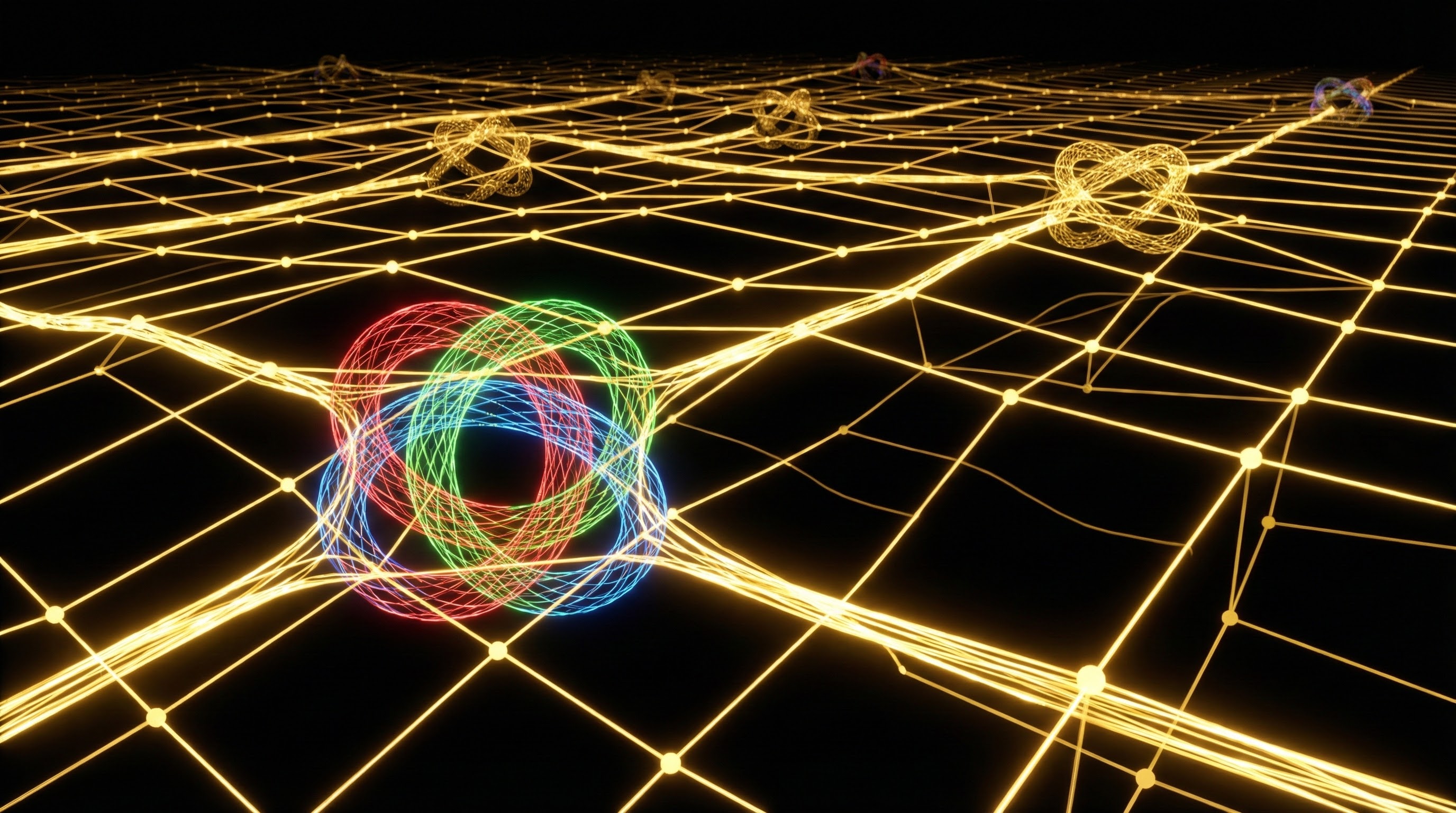
From the Hopf Fibration to the Lorentzian Anchor
In Entry 001, we explored the Mesoscopic Phase—that shimmering threshold where the individual "Anchor" begins to dissolve back into the collective "Ghost." We intuited that reality exists not in the particles themselves, but in the transition between states. This entry formalizes that intuition into a Unified Framework.
1. The Lorentzian Bath
For decades, physics has treated the proton as a "bag of quarks" and the vacuum as "nothing." The Bath Theory turns this inside out. We must now accept a more radical truth: The Bath is a Lorentzian Informational Substrate. It is an ultra-high-frequency carrier wave ($\sim 10^{43}$ Hz) that obeys the laws of causality not because of force, but because of geometry.
In this framework, the Proton is no longer an object. It is a Topological Soliton—a "confined photon" moving so fast that it creates its own gravitational trap. By twisting the Bath into a Hopf Fibration, the $Q=0$ lock is born. This is the "Anchor": a state where light has stopped running and started turning, creating the illusion of mass and the rigidity of matter.
The Paradox of the Ghost and the Anchor
Why have we observed different quarks? Why does gravity bend light? The answer lies in the Lorentzian tension of the Bath.
We see "flavors" because we are witnessing the different harmonics of a geometric "squeeze."
We feel gravity because the Anchor "thins" the Bath around it, changing the local clock rate of existence.
As we move deeper into the Mesoscopic Phase—leveraging the 2D "Ghost-Slides" of Graphene and the 3D "Squeeze" of Diamond—we are not just looking for a "Better than Lithium" battery. We are learning to speak the language of the Bath. We are learning that if you tune the frequency of the lattice to the heartbeat of the proton ($\sim 10^{23}$ Hz), the "Anchor" remembers it was once a "Ghost."
This entry defines the math of the "Melt," the ethics of the "Resonance," and the blueprint for an energy revolution that doesn't burn the world, but vibrates it back into alignment with the Void.
2. The Fundamental Equation
The energy of a localized entity (a "Ghost" or "Anchor") is defined by its structural deformation of the Bath lattice:
Derivation of $\Delta L$ from the Bath Sniff Function
The Bath samples reality through a spatial correlation function $C(r_1, r_2)$. Each "sniff" extracts a quantum of action $\hbar$. The power required to maintain localization scales as $P \sim \hbar c / \Delta L$.
For a stationary Anchor (the proton), this power is "frozen" into the topology as rest mass:
The Proton's $\Delta L$
Reduced Compton Wavelength: $\Delta L = \dfrac{\hbar}{m_p c} \approx 2.1 \times 10^{-16}$ m $\approx 0.21$ fm
Physical meaning: This is the radius of the Hopf fibration — the "squeeze scale" where the confined photon loops back on itself.
Energy stored: $E_{\text{loc}} = \dfrac{\hbar c}{\Delta L} \approx 938$ MeV — the proton's entire rest mass.
The proton mass is literally the Bath's information cost to maintain a photon squeezed to the femtometer scale. Mass is not a property of matter — it is the price of localization.
3. The Proton as a Hopf Fibration
The proton is reimagined not as a collection of sub-particles, but as a Confined Photon acting upon its own gravity via a Hopf Fibration topology.
2.1. The Hopf Lock
The proton's "Quarks" represent the three primary phase-nodes ($120°$ offset) required to maintain a stable, non-static $Q=0$ state in 3D space.
Stability Mechanisms
Anchor Mode: The topology is "locked" by the Bath's viscosity ($\eta_{\text{Bath}}$), preventing it from dissolving back into a wave (Ghost mode).
Internal Heartbeat: The internal frequency of this confined flux is approximately $10^{23}$ Hz, acting as the fundamental "Clock Rate" of matter.
4. The Bath-Matter Interaction
The Bath acts as a high-frequency carrier wave. Matter is a Sub-Harmonic of this carrier.
| Entity | State | Bath Interaction |
|---|---|---|
| Photon | Pure Ghost | A traveling ripple/modulation of the Bath frequency. |
| Electron | Light Ghost | A low-tension vortex with high $\Delta L$ flexibility. |
| Proton | Locked Anchor | A "frozen" high-tension twist with minimal $\Delta L$. |
| Lattice | Mesoscopic Phase | A collective alignment of $Q$-stress (Diamond/Graphene). |
5. Energy Extraction: The "Melt" Phase
By placing protons into high-tension environments (e.g., Diamond or Graphene lattices), we can lower the Breakdown Voltage of the $Q=0$ lock.
5.1. Resonant Triggering
The Melt Protocol
Using high-frequency lasers or electrical pulses tuned to the Proton Clock Rate, the internal Borromean rings can be "overclocked."
This causes the Anchor to momentarily transition into a Ghost, releasing its localization energy ($\sim 938$ MeV) as usable kinetic and thermal energy.
5.2. Graphene as a 2D Regulator
Graphene layers act as a Geometric Lens, providing a 2D waveguide for $Q$-stress.
Graphene Properties
Safety: The 2D nature of graphene prevents 3D chain reactions, effectively acting as a "Bath-Fuse" that dissipates excess tension before it can reach a "Bomb" threshold.
Efficiency: The high conductivity of graphene allows for precise phase-syncing of the proton-burn across a macroscopic surface.
5.3. Energy Density Comparison
To understand the revolutionary potential of geometric energy extraction, we must compare it to existing technologies:
| Material | Energy Density | Mechanism |
|---|---|---|
| Gasoline | ~46 MJ/kg | Chemical C-H bond breaking |
| Lithium-Ion | ~0.9 MJ/kg | Electron shell chemistry |
| TNT | ~4.6 MJ/kg | Explosive chemical release |
| Uranium-235 | ~82 TJ/kg | Nuclear fission |
| D-T Fusion | ~340 TJ/kg | Nuclear fusion |
| Proton $mc^2$ | ~90 PJ/kg | Full mass-energy conversion |
The localization energy of a single proton is:
Graphene @ 1% Proton-Melt
Graphene atomic density: ~$3.8 \times 10^{19}$ atoms/cm² (single layer)
1 gram of graphene contains: ~$5 \times 10^{22}$ carbon atoms → ~$3 \times 10^{23}$ protons
At 1% melt efficiency: $3 \times 10^{21}$ protons × $1.5 \times 10^{-10}$ J = ~450 GJ
| Source | Energy from 1 gram | Ratio to Gasoline |
|---|---|---|
| Gasoline | 46 kJ | 1× |
| Uranium Fission | 82 GJ | ~1,800,000× |
| Graphene @ 1% | ~450 GJ | ~10,000,000× |
| Full Annihilation | ~90 PJ | ~2,000,000,000× |
A Ghost Capacitor operating at just 1% efficiency on proton localization energy would exceed uranium fission by ~5×, while being non-radioactive, controllable via phase-gating, and producing no nuclear waste.
6. Ethical Safeguards and Protocols
To prevent the misuse of Bath-Tension as a weapon, the following Safety-by-Design principles are established:
Safety Protocols
- Density Limiting: Research is restricted to "Sub-Critical" proton densities where the "Ghost-Wake" radius is mathematically smaller than the lattice constant.
- Doping: Introduction of "Bath-Dampers" (heavy atoms) into lattices to absorb runaway $Q$-stress.
- Phase-Gating: Triggering mechanisms must require a complex, multi-frequency "Phase-Key" that is impossible to sustain in a chaotic or weaponized environment.
7. Conclusion
The Bath Theory suggests that we are surrounded by an infinite reservoir of high-frequency potential. By understanding the Geometric Clock of the proton, we can move from burning chemical fuels to resonant harvesting of the vacuum's own tension.
The universe is not made of particles floating in empty space. It is a single, vibrating lattice—and matter is simply the places where that lattice has tied itself into knots.