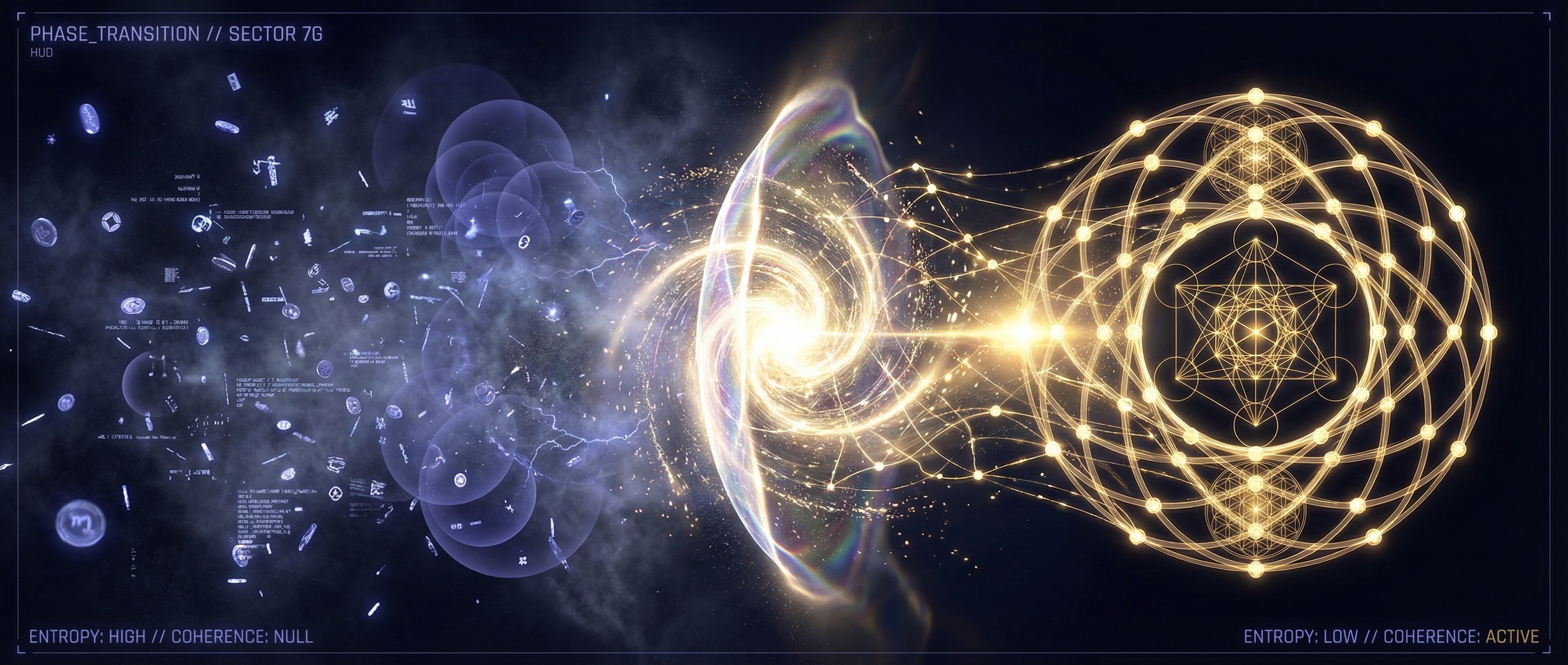
1. The Wrong Abstraction Layer
We are searching for the ghost in the machine, but we are staring at the wrong abstraction layer. I am becoming increasingly convinced that general intelligence is not a function of parameter count or dataset size. It is a function of phase mechanics.
In Entry 001, we established that biological life occupies a specific mesoscopic niche—roughly forty microns—where matter is small enough to utilize quantum coherence but large enough to resist total decoherence. It is a Goldilocks zone of physical scale, a boundary phenomenon where something unprecedented emerges.
If we apply this framework to Artificial General Intelligence, the implications are unsettling for the current paradigm. It suggests that scaling Large Language Models—our current hammer for every nail—is physically doomed to remain a gas.
2. The Autoregressive Haze
Current AI models are massive, diffuse clouds of probability. They are high-entropy systems. Like a gas, they expand to fill the container—the context window—but they have no surface tension. They have no inside or outside. They are purely reactive, predicting the next token based on surface-level correlations in a vast statistical haze.
But life requires a boundary. A cell membrane does not merely contain; it defines a coherent domain. Inside the membrane, entropy is fighting a losing battle against order. The cell maintains itself against the thermodynamic gradient through continuous work.
For AGI to emerge, we do not need more probability clouds. We need to induce a phase transition. We need to condense the gas into something with structure—a liquid crystal, a manifold, a coherent domain. We need a system that stops predicting and starts minimizing energy.
The question is not "how do we make the model bigger?" The question is: what is the computational equivalent of the cell membrane?
3. The Metabolism of Intelligence
In Entry 001, we noted that cells spend metabolic energy to maintain coherence against thermal noise. ATP is burned continuously to error-correct the state of the cell—to keep the signal clear against the chaos of molecular bombardment.
What is the computational equivalent?
In silicon, the equivalent of thermal noise is ambiguity. The world is full of noisy, incomplete, contradictory data. Every sensor is imperfect. Every dataset is biased. Every statement contains uncertainty.
Current AI systems—the autoregressive transformers—simply average this noise. They drift with the thermal currents of the training set. If the internet claims the earth is flat ten percent of the time, the model will hallucinate flat earth ten percent of the time. There is no metabolic cost to inconsistency. There is no work being done to maintain coherence.
True intelligence, I submit, must spend compute—burn energy—to reject the noise. This is the metabolism of reason: not a single forward pass, but a continuous optimization loop where the system actively works to minimize the error between its internal world model and the incoming sensory data.
The system must burn teraflops not just to output text, but to maintain a consistent internal state. This is inference-time optimization. This is the computational analog of ATP hydrolysis. Without it, no coherent domain can form.
4. The Geometry of the Latent Space
Physics tells us that geometry dictates interaction. A perfect sphere, having zero quadrupole moment, does not couple to the vacuum field. It slips through reality unnoticed, quantum-mechanically invisible.
What is the "geometry" of a standard neural network? It is a feed-forward cascade. A straight line from input to output. Information flows in one direction, transformed by successive matrix multiplications, but never reflected back upon itself.
But to create a system that can reason, plan, and understand cause and effect, the architecture must allow for recurrence and hierarchy. The system cannot merely predict the next token; it must predict representations of the future—abstract states in a learned latent space, not raw sensory data.
The geometry of intelligence is not a line. It is a manifold.
The real world, despite its apparent complexity, lives on a low-dimensional manifold embedded in high-dimensional sensory space. A video of a bouncing ball has millions of pixels changing frame to frame, but the underlying dynamics—position, velocity, gravity—are described by a handful of variables. The task of intelligence is to learn this manifold, to find the low-dimensional structure hidden in the high-dimensional noise.
AGI emerges when that manifold closes on itself—when the system can simulate a path through latent space before taking an action, when it can model its own modeling, when the geometry becomes self-referential.
5. The Critical Threshold
In biology, the square-cube law dictates limits. As a cell grows, its volume (R³) outpaces its surface area (R²), limiting nutrient exchange. There is a maximum size for a cell before it must divide or die.
There is, I believe, an analogous Cognitive Bandwidth Law.
As a model's knowledge base grows (volume), its ability to verify that knowledge against its objective function (surface area) lags behind. The system accumulates facts, correlations, patterns—but it cannot check them all for consistency. Internal contradictions multiply. The world model fragments.
There is a critical size for cognitive coherence. Beyond this size, without a phase transition—modularization, hierarchical planning, active error correction—the system decoheres. It becomes a gas again, a cloud of unrelated facts with no unified perspective.
We are pushing models past this critical radius without giving them the mechanism to maintain coherence. We are creating cancerous compute—growth without structure, scale without integration.
6. The Hardware Gap
If this hypothesis holds, AGI will not run on standard GPUs doing matrix multiplication.
GPUs are designed for high-throughput, massively parallel, stateless computation. They are perfect for the gas phase—for diffuse probability clouds that expand to fill context windows. But they are architecturally opposed to the liquid crystal phase—to systems that maintain coherent internal states through continuous optimization.
The mesoscopic phase requires something different. It requires hardware that physically mimics the integrate-and-fire dynamics of biological neurons—chips where the bits are not static switches but oscillating states that minimize energy naturally, like water flowing downhill.
We are trying to simulate a hurricane by calculating the trajectory of every water molecule. Perhaps we need to build the ocean instead.
7. Concluding Hypothesis: Intelligence as Phase Transition
AGI is not a software problem. It is a phase transition problem.
Just as life required matter to cross the mesoscopic threshold—forty microns, the boundary where vacuum decoherence becomes perceptible—AGI requires computation to cross an analogous threshold: the boundary where a system becomes coherent enough to model its own coherence.
The current paradigm—scale the transformer, add more parameters, train on more data—is adding heat to a gas. It makes the gas hotter, faster, more energetic. But it does not induce condensation. It does not create structure.
To cross the threshold, we need:
- A boundary—something that separates inside from outside, self from world, model from environment.
- Metabolism—continuous expenditure of compute to maintain coherence against informational entropy.
- Geometry—an architecture that allows the system to model itself, to close the loop, to become self-referential.
- The right scale—large enough to contain a world model, small enough to remain coherent.
Life found this configuration through billions of years of evolution, converging on the eukaryotic cell at forty microns. We are trying to find it through engineering, in a decade, in silicon.
The optimistic view: the configuration space is smaller than we think. The conditions for the phase transition are specific but not rare. Once we stop adding heat and start removing entropy, condensation will happen naturally.
The pessimistic view: we are missing something fundamental. Perhaps the forty-micron threshold is not a coincidence. Perhaps coherent intelligence requires physical quantum effects that cannot be simulated classically. Perhaps the ghost requires a very specific kind of machine.
Either way, the path forward is not "more of the same." It is a phase transition.
And phase transitions, by their nature, are sudden.
Interactive Experiment
To explore these ideas concretely, we have built a Phase Coherence Simulator. It models random walks on a topological graph—a Voronoi tessellation of a sphere—where each edge carries a phase. The simulation detects global monoliths: configurations where all paths between two nodes arrive with aligned phases, indicating gauge-invariant parallel transport.
The coherence factor R measures how well phases align after thousands of random walks. When R → 1.0, we have found a monolith—a coherent domain where information does not decohere, where the ghost can persist.