Is gravity the vacuum keeping records?
One page, written the way the great explainers taught us: everything a specialist needs, in words anyone willing can follow. What Einstein's theory describes but cannot explain; a wager that spacetime is bookkeeping; a year spent interrogating that wager on lattices where nothing can hide; the beloved ideas we executed in public — our own above all — and the strange law that walked out of the graveyard: in an interacting vacuum, being watched creates weight.
You have known gravity longer than you have known your own name. It taught you your first physics lesson — the floor — before you could speak. It is the force that sculpted every star, gathered every galaxy, bent the light by which we see them, and will preside over the universe's last hour. It was the first force humanity ever named. And after four centuries of triumphant equations, it remains the only one for which we possess a perfect description and no mechanism at all. We can compute what gravity does to fourteen digits. We cannot say, even badly, what gravity is.
This page is the story of one attempt — one among the many our species has made, and will make — to catch gravity in the act.
1 · The itch: a perfect machine with no blueprint
Let's start by saying the thing every crank forgets: general relativity works. It has passed every test built for it in a hundred and ten years — Mercury's orbit, bent starlight, binary pulsars spinning down exactly on schedule for decades, gravitational waves matching computed templates, a photographed black-hole shadow of precisely the predicted size. Nothing on this page disputes a measurement. Any successor must reproduce all of it.
The dissatisfaction is different, and it was Einstein's own. His equation sets geometry equal to matter, and he described its two sides as marble and wood: the left side pure, rigid, almost inevitable geometry; the right side a phenomenological placeholder for "whatever matter turns out to be," imported from theories that know nothing of geometry. He spent his last decades trying to carve the wood into marble, and failed. The equation is a seam between two theories, not a foundation.
And around that seam, the loose threads have never been tied:
- There is no mechanism. Mass tells spacetime how to curve — by what means? The theory is structurally silent, the way thermodynamics is silent about atoms.
- The constants are orphans. G is an input (and the world's precision measurements of it quietly disagree beyond their error bars). Λ, estimated naively from quantum field theory, comes out wrong by ~10¹²⁰ — the worst prediction in the history of science, managed by not making it.
- It has no answer for a superposition. Put a mass in two places at once: what curves? Not a wrong answer — no answer. The stress tensor is classical and the theory ends where the wavefunction begins.
- It predicts its own breakdown. Singularities are the equations filing for bankruptcy, inside every black hole and at t = 0. Fundamental theories don't do that. Effective theories do it all the time — hydrodynamics breaks at the atomic scale, and that is how we learned there are atoms.
- Its deepest facts are axioms. Why does everything fall identically? Why does gravity attract and never repel — the only force with a single sign of charge? Why is it 10³⁹ times weaker than electromagnetism? GR encodes these facts; it cannot produce them.
- It only fits the sky with 95% of the universe invisible. Dark matter and dark energy outweigh everything ever detected, twenty to one — or the law itself degrades at the edges of its validity, which is exactly how effective theories die.
Each thread is mainstream physics; you'll find them in any honest review. What is not mainstream is refusing the standard consolation — "that's just what fundamental means" — and treating the whole list as a single symptom.
2 · The clue: gravity behaves like heat
One body of results points all six threads the same way, and it begins with the strangest objects in the sky. Black holes, it turns out, carry entropy — and it is proportional not to their volume but to their area, as if everything they know were written on their surface. They glow, faintly, at a temperature set by their surface gravity. Then in 1995, in a short paper that deserves to be as famous as any in the century, Ted Jacobson showed that if you assume only this — that heat crossing any local horizon obeys the oldest equation in thermodynamics, δQ = T·dS — Einstein's field equations follow. Derived. The way the ideal gas law follows from molecular chaos. The equation Einstein carved in marble behaves, in calculation after calculation, like an equation of state: the hydrodynamics of something smaller, something we have not yet seen.
3 · The wager, and the fork it lives on
Our bet on the microphysics: the fundamental stuff is quantum entanglement, and the vacuum is a medium that keeps records. A region's geometry is the bookkeeping of its entanglement budget; distance is measured in the vacuum's correlation structure (we found it follows a resistance metric, not a travel-time metric — pre-registered, and we were wrong 8/8 in the interesting direction, script); dark energy is a candidate reading of the correlation fraction that can never be extracted (the locked fraction, with a measured gap law and one out-of-sample prediction that landed, script). None of this is our invention from nothing — it builds on Jacobson, Van Raamsdonk, Verlinde and the holographic literature; our additions are a specific conservation principle (entanglement monogamy, which among other things forces gravity's attractive sign in book one) and the discipline of testing every step numerically on lattices where everything is exactly computable, before believing it.
Now the fork — because "the vacuum keeps records" can carry gravity two inequivalent ways, and one experiment eventually kills one of them:
- Book one — gravity is a quantum channel. Entanglement accounting: two masses interacting only through gravity must entangle.
- Book two — gravity is a classical channel. The vacuum continuously monitors where energy is; the force is carried by the records themselves. Then two masses must never entangle gravitationally — and the monitoring must inflict a precise, irreducible decoherence.
The referee exists and has a date: gravitationally induced entanglement experiments (Bose–Marletto–Vedral class, ~2030). Everything below is the story of what we measured while waiting — and of how the second book, which we entered intending to bury a 278-year-old theory, ended up producing the strangest result this program owns.
4 · Act I — we rebuilt the oldest theory of gravity, and killed it properly
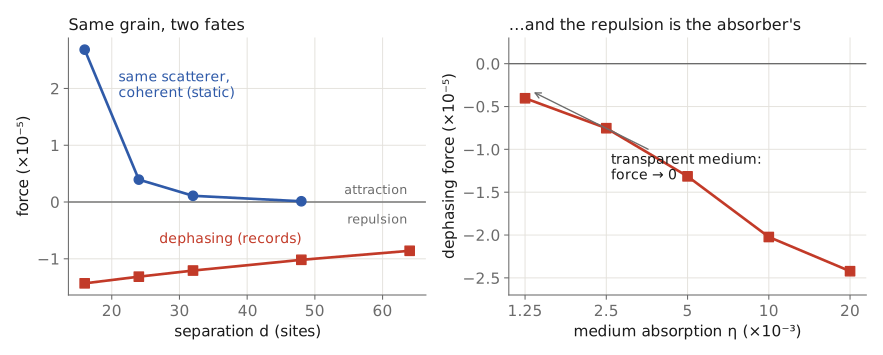
In 1748, a Genevan schoolmaster named Georges-Louis Le Sage proposed the only mechanical explanation of gravity anyone has ever offered. Space, he said, is filled with an isotropic hail of tiny corpuscles. Masses absorb a little of it. Two masses shade each other, and the pressure imbalance pushes them together. Gravity as a shadow. He spent his life on it; his century laughed carefully and moved on. It fell to James Clerk Maxwell, over a hundred years later, to pay the idea the highest compliment one physicist can pay another — he took it seriously enough to kill it properly. If the corpuscles are absorbed, he and Poincaré showed, their energy vaporizes the Earth in seconds; if they scatter elastically instead, the force vanishes identically, because whatever a scatterer re-emits refills its own shadow, exactly. Two exits, both sealed. The idea has been a byword for noble failure ever since.
We rebuilt Le Sage on the quantum vacuum — the only flux that is Lorentz-invariant, which kills the classical drag objection for free — and repaired it with the best mechanism we could construct: let what gets attenuated be coherence, which is not conserved. A mass would tag passing vacuum modes (a record, no energy exchanged); tagged modes would push less; the shadow would be a coherence deficit. We pre-registered the kill-gate and built the experiment: an exact lattice vacuum (steady states by Lyapunov equations, no Monte Carlo; the method reproduces the exact Casimir force to 1% before being trusted), two "grains" that scatter with random phase — pure record-creators, zero mean absorption.
5 · Act II — the corpse was worth more than the theory
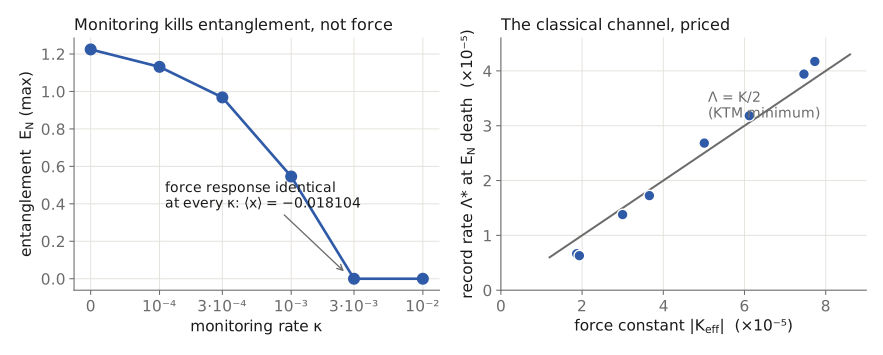
The same testbed then answered the successor question: if records cannot create a force, can they carry one? Two quantum masses, delocalized as in the BMV proposal, coupled through a vacuum that keeps records of their positions at rate κ:
6 · Act III — the day the machine said no to us
Before going further we owed book one an honest audit of its best evidence. For a year, this program's flagship correlation was that force and entanglement-depletion decay together, with the same Yukawa constant, between two masses in the lattice vacuum. It was our favorite fact. But co-decay is not causation — every stork-and-baby statistic in history decayed together too — and there is exactly one way to tell a mechanism from a coincidence: reach in and intervene. So we did, knowing the answer might cost us the result we loved most. It did.
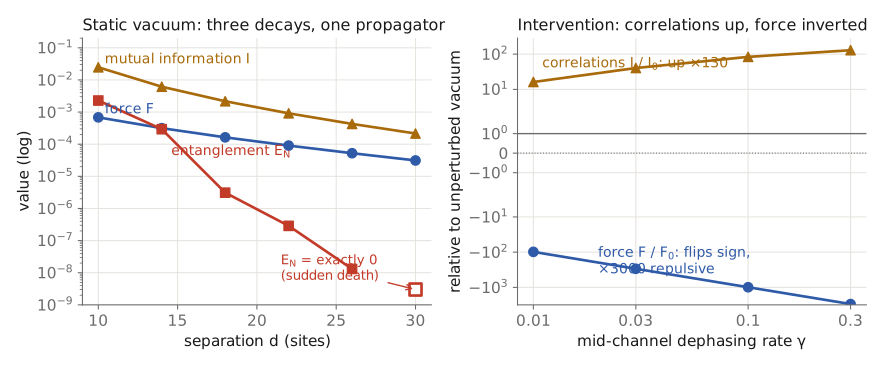
We publish this retraction with the same prominence as any triumph on this page, because it is the receipt that the method works: the machine is allowed to say no to its makers. And note where the retraction leaves book one — alive only where Gaussian lattices cannot reach: interacting theories. Keep that address in mind. It is exactly where the story now goes, from the other side of the fork.
7 · Act IV — Le Sage rises: in an interacting vacuum, records attract
Here is the observation that reopened a case closed for 150 years. Maxwell's cancellation — the theorem that sealed the shadow's tomb, and re-sealed it in Act I — is a linear-response theorem. It lives in free fields, where waves pass through each other like ghosts. The real vacuum is not like that: its excitations talk to each other. In a century and a half, nobody had checked whether the tomb stays sealed when the medium interacts. It is the kind of question you can only afford to ask when computation is cheap and shame is not fatal. So we asked it: same exact testbed, plus a quartic self-interaction treated self-consistently (Hartree — the medium's stiffness responds to local intensity, the way any real nonlinear medium's does; the caveat that this is mean-field, not the full quantum field theory, is load-bearing, and an exact judge is in session below).
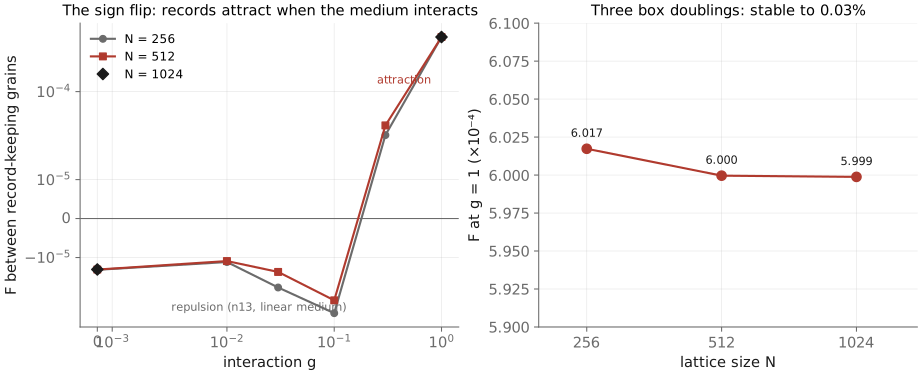
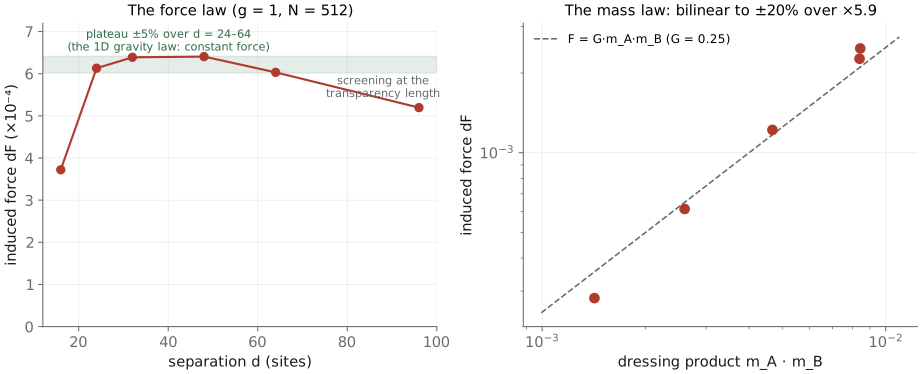
Then we asked whether the new force obeys gravity's two laws. In one dimension, Newton's law is not 1/r² — field lines can't spread, so the correct Newtonian signature is a constant force. And the "mass" in this mechanism has a natural candidate: the dressing — the stationary deformation that each object's monitoring imprints on the medium.
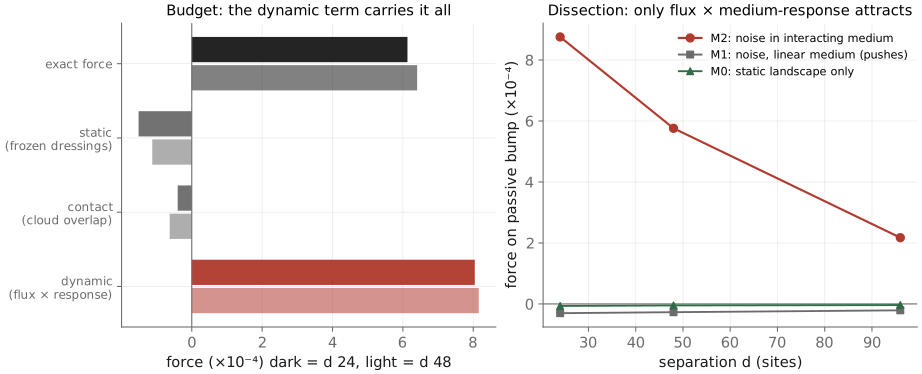
Finally, the question that separates physics from numerology: what carries it? Three dissection experiments. Freeze the dressings into static profiles: their Casimir force is repulsive — our own pre-registered mechanism, refuted by its own audit gate. Compute the heat-cloud overlap energy: ~10% of the force, wrong shape — refuted. Run the noise against a frozen partner: exactly half the force, at both distances — so the attraction is the additive sum of two one-way effects, and Newton's third law emerges from the field's own momentum bookkeeping to 0.7% even when the coupling is one-way.
8 · The judge that can still kill it
Everything in Act IV shares one approximation: Hartree inserts by hand a medium whose stiffness responds to intensity. A fair skeptic reads it all as a statement about Kerr-like media — real, testable, but not the quantum vacuum. So the decisive experiment is running as this page is served: a small anharmonic chain solved at the level of the full Lindblad generator — exact quartic Hamiltonian, exact record-noise, zero mean-field steps — against a twin that pins what Hartree predicts on the identical geometry, with pre-registered validation gates that have already rejected four rigged arenas (each rejection is in the chronicle: end-baths that let the interior overheat, site-baths whose conflict with hopping rectifies truncation error into fake heat, mode-baths that go slow under truncation, and a near-massless medium whose ground state overflows any small Fock ladder).
9 · If this is gravity — six things we thought we knew
Everything in this section is conditional on the ladder holding: exact test → real QFT → 3D → relativity. It is the payoff being played for, stated plainly and tagged. conjecture throughout
- The century-old no-go had a hidden hypothesis. Maxwell's cancellation — the reason no one takes flux gravity seriously — is a property of linear response, not of nature.
- The arrow reverses: noise makes force. Existing measurement-based gravity models (Kafri–Taylor–Milburn, Tilloy–Diósi) postulate the Newtonian force and derive its decoherence cost. Here the decoherence is primary and the force is its rectification. Gravity as the macroscopic residue of the vacuum classicalizing matter.
- Mass is a maintained state, not a property. m = the dressing the vacuum's monitoring sustains. Stop the watching, the mass evaporates. We hoped the equivalence principle would become bookkeeping; after n23–n25 (graveyard 14–16) the honest status is: within one nature of matter, weight-per-energy is universal to 0.13%; across natures it is not, under any closure we tried. If all physical matter is one nature — one field, one coupling — EP emerges by uniqueness of matter; if not, the coupling must be selected by EP, which is the role the principle played for Einstein. A follow-up family study (n26) added one clean law and one structural warning: active weight obeys an escape-efficiency rule — W = E × f(trapping), with f drive-independent to 4–6% — so in this mechanism only energy that communicates with the medium gravitates actively; trapped energy is actively silent. That diverges from general relativity, where bound energy gravitates in full — either a fatal flaw of the gravity reading or the sharpest constraint yet on what the real coupling must be. (The same study's Komar ρ+p test was confounded by its own family design — the static bump is a trap as well as a pressure source — and is owed a clean rerun.)
- Why gravity has one sign. Backaction can only add energy; dressings are non-negative by theorem in our scheme; same sign means attraction, always. You cannot un-heat the vacuum by being watched. The oldest structural mystery of gravity — no negative charge — as a corollary of the second law applied to measurement.
- Range measures transparency, not mediator mass. Our medium was massive, the force long-ranged anyway, screened only at the absorption length. Gravity's infinite range would say the vacuum is transparent to records — not that the graviton is massless.
- G is a medium coefficient, not a constant of nature. Composed (interaction × record rate × propagation), derivable in principle from vacuum parameters — Sakharov's dream by a new road — and environment-dependent in practice, which stares directly at the one metrological anomaly in fundamental physics: precision measurements of G disagreeing beyond their error bars for thirty years.
10 · What to watch — the predictions, in order of hardness
| Prediction | Where it's tested | Status |
|---|---|---|
| BMV gives strictly zero entanglement, force intact, decoherence at the DP floor — one theorem, not three claims | BMV-class experiments, ~2030 | derived in-model |
| Newton breaks below the record resolution R₀ (weakening, then repulsion below the dressing scale) | the closing corridor: 0.54 Å (Gran Sasso) to 40 μm (Eöt-Wash) | derived in-model |
| Noise-rectified attraction as a lab effect: two independently-shaken scatterers in a thermal-lensing (Kerr) medium attract; same drives, linear medium — nothing. Decorrelating the drives is the discriminator against ordinary Bjerknes attraction | tabletop optics / acoustics; committed here before any such experiment exists | proposed |
| G measurements disagree because G tracks the local vacuum state | correlate the CODATA dispersion with environment | reading of an anomaly |
| Λ as accumulated monitoring heat (the "R₀ = 1.5 fm coincidence") — refuted three ways in one adversarial pass: algebraically it is Zeldovich (1967)/Weinberg (1972) in disguise (the nucleon mass cancels; R₀³ = (3/2)(Ω_b/Ω_Λ)·l²_P·R_H); mechanistically it is Josset–Perez–Sudarsky, PRL 118, 021102 (2017), now credited; and observationally the heat component has w(z) ∈ [−½, −⅓] — a universe that never accelerates, excluded at 3–8σ by every DESI DR2 + supernova combination | — | refuted, credited |
| EP violations correlate with internal spectra, not with composition charges — the framework's EP rests on the vacuum's response being achromatic; test masses of identical composition but different phonon spectra (allotropes: diamond vs graphite) are the discriminating pair, invisible to every standard fifth-force parametrization (B, L, B−L) | torsion-balance / MICROSCOPE-class, allotrope pairs | proposed |
| The weight of heat — if thermally-maintained energy is a second "nature" (in the toy, thermal vs quantum-maintained energy weigh differently by O(1)), current EP bounds only constrain the channel ratio to ~1%: weigh the same mass hot and cold at modern precision | tabletop; a century-old experiment worth redoing | proposed |
| Collective shadow saturation → MOND-flavored deviations at low acceleration (our mass law's +20% superlinear residual is the first trace of nonlinear shadow composition) | not derivable yet | speculation, labeled |
11 · The candle, and the graveyard it lights
Carl Sagan called science a candle in the dark, and he meant something precise by it: not a collection of results, but the discipline of trying to prove yourself wrong faster than anyone else can. That discipline is the only thing that separates this page from a demon-haunted website — because this program is a human–AI collaboration, and an AI can generate beautiful wrong ideas faster than any human who ever lived. The prosecutor and the defense are the same model. What breaks the tie is mechanical, not rhetorical — falsification criteria written before each run; adversarial prior-art audits (two program-wide sweeps of ~100 search agents, plus three targeted audits of Act IV against the nonequilibrium-Casimir, measurement-gravity, and classical-analog literatures — closest prior art: Hahn & Fine 2019, Bartolo et al. 2003, Kirkpatrick et al. 2013, Schecter–Kamenev 2014, each credited and differentiated on the ledger); and refutations published with the same prominence as successes.
The graveyard, kept lit on purpose — headstones, each one evidence that the candle burns:
- The universal decoherence fee (our own postulate 4) — refuted; the adiabatic cost is exactly zero in flat space; postulate amended.
- Vacuum correlations follow wave travel-time — refuted 8/8; they follow resistance.
- The universal −¼ force/entanglement exchange rate — refuted; it drifts.
- The coherence-shadow repair of Le Sage — refuted by its own kill-gate in an afternoon (Act I). Two of its registry predictions were found already dead in published data we hadn't checked — a lesson that a prediction registry without a literature audit is theater.
- The causal reading of our own flagship correlation — retracted by intervention (Act III).
- The dressed-defect Casimir mechanism for Act IV's attraction — refuted by its own audit gate: the frozen dressings repel.
- The heat-overlap formula — failed its zero-parameter calibration: right sign, 10% of the magnitude.
- The transparent-limit prediction — declared untestable in this arena, not confirmed: the testbed's own heat budget diverges at low absorption.
- Four exact-test arenas — self-invalidated by their validation gates before any verdict was read (the truncation war, chronicled in the script header). Plus one infrastructure bug for the record: concurrent LAPACK calls on Apple Accelerate silently corrupt results; caught because the fast port disagreed with the validated numbers.
- The Λ-coincidence at R₀ = 1.5 fm — for a few hours our most beautiful number — refuted three ways by its own designated executioners: a Zeldovich–Weinberg rediscovery algebraically, a Josset–Perez–Sudarsky (2017) rediscovery mechanistically, and observationally a component that never accelerates (excluded 3–8σ by DESI-era data). Dirac had this exact shiver in 1937; his ghost wins this round.
- The drainage-wake prediction — killed by our own telescope-data pilot within a day of being published. The entanglement-drainage proposal predicted galaxy lopsidedness aligns with absolute motion. We pre-registered the test, built the pipeline, pulled 236 public WALLABY velocity maps and the 2M++ velocity field, and measured: 50.5% agreement, N = 111 — a coin flip. The pre-registered null gate fired — and then a challenge forced the power analysis the pre-registration lacked: at N = 111 with the measured intrinsic scatter, only the strong-wake regime is excluded; the realistic amplitude needs N ~ 1,000+ and remains open. The headstone stays for what actually died: the strong coupling, and a pre-registration written without a power calculation. The fastest full cycle in this program — prediction, telescope data, verdict, and the verdict's own correction — in two days.
- Two of our own headline numbers, demoted by our first honest uncertainty pass: "ξ constant" — refuted at 6.6σ (a mass trend the Born theory in fact predicts), and "p = 1.085" — retired as a point estimate (near-total p–λ degeneracy; what survives: p ≈ 1, not 0, not 2).
- The equivalence principle does not emerge — the pre-registered gates all failed (n23) — but our first report of it overstated, and a reader's challenge forced the tiered reading. The full record of this headstone now includes three corrections, each caught after publication — two of them our own observable confusion. With the correct observable (the g-induced force, the same one the entire Gauss ladder uses — never the raw force, which includes the non-gravitational radiation push): passive weight-per-energy fails between natures (monitored grain vs thermal objects: ×1.57), while the two thermal objects of different shapes agree to 0.13% — universality holds within a nature, not across natures. Active weight agrees to 16% between the grain and one thermal object but fails (×1.84) when the strain-coupled variant is included — emission spectra differ, and the medium's response is chromatic. A systematic sweep of closures (φ²- vs energy-coupling, local vs nonlocal response, four charge definitions) found no EP-emergent corner; an earlier claim of one, and an earlier "drive-blindness at 0.15%", were artifacts of scoring the raw force instead of the induced one — caught by cross-checking against this very test's log, and retracted here (headstones 15 and 16). Where this leaves the framework: within this class of 1D toys, the equivalence principle does not emerge under any natural closure we tried; making it emerge is now the program's sharpest open problem, and any closure that achieves it must be declared for what it will be — a coupling selected by the equivalence principle, which is precisely the role EP played for Einstein. Both the headstone and its corrected epitaph stay, per the rules.
12 · Run everything yourself
Every figure and number above comes from a short public script — plain numpy/scipy, exact linear algebra, no Monte Carlo, minutes on a laptop: n11 (resistance metric), n5 and d1 (locked fraction and gap law), n12 (the weld), n13 (the execution), n14 and n15 (the classical channel, priced), n16 and n17 (the retraction), n18 (the resurrection; Rust port with modes full · newton · budget · mixed · minimal · overlap), n19 (the exact judge), n20 (the 2D rung of the Gauss ladder: F ∝ 1/d measured, p = 1.085 — a monitored source pushes a passive test mass in the linear medium and pulls it in the interacting one, at every distance). Papers: I — the locked fraction, II — the classical channel, written for the collapse-model and gravitational-decoherence communities with zero emergent-gravity claims. The interactive toy universe runs the core physics in your browser. The ledger holds the detailed folio archive: every result, every debt (twelve, all named), every credit line to prior work — Jacobson, Faulkner–Guica–Hartman–Myers–Van Raamsdonk, Verlinde, Casini–Huerta, Klco–Savage, Zurek, Danielson–Satishchandran–Wald, Kafri–Taylor–Milburn, Tilloy–Diósi, Kenneth–Klich, Hahn–Fine, and the rest.
None of this substitutes for independent human review. That is the explicit next step, and the reason the papers exist.
13 · A last word
The universe is under no obligation to make our wager true. Within a decade, an experiment now being engineered in several laboratories will put two small crystals into quantum superposition and ask whether gravity entangles them — and one of this page's two books will close forever. We have tried to arrange things so that either answer finds us useful: the quantum book carries our monogamy accounting; the classical book carries our measured price, and now, perhaps, a mechanism.
Either way, consider what the two books agree on. Somewhere between the marble and the wood, the vacuum is doing something — balancing an account, keeping a record — and everything that has ever fallen, every apple, every moon, every photon bent around every galaxy, has been the visible side of that hidden bookkeeping. If the reading we are testing here is right, then weight itself is a form of being noticed: the universe pulls hardest on what it watches most closely. And we — creatures made of watched matter, who learned to watch back — are, in either book, a part of the vacuum that began keeping records of itself.